Behavior & cognition
How smart are alpacas? What cognition research and training show
Timm Quandt8 min read
Alpacas often seem calm to stubborn, and it’s easy to get the impression that they are simple-minded. Behavioral studies from recent years paint a different picture. In detour tasks, alpacas show an impulse control that other grazing animals don’t reach, llamas learn from other llamas and from humans, and individual animals can even be told apart by their voice. How far this alpaca intelligence goes, what it means for training and where the therapy enthusiasm around these animals goes beyond the evidence is what this article covers.

The key studies at a glance
If you’re in a hurry, you’ll find the core findings here. After that, I go into training, handling and the therapy question in detail.
| Study | Sample | Key finding |
|---|---|---|
| A-not-B detour test | 51 alpacas | No perseveration errors, better impulse control than dog, horse, donkey and mule |
| Observational learning | 30 llamas | 7/10 solve the task after a human demo, 6/10 after a llama demo, 2/10 without |
| Voice recognition | Classifier on “hums” | 71 % correctly assigned to the right animal |
| Personality | 44 alpacas | Stable individual differences, females more reactive than males |
How smart are alpacas? The detour test gives an answer
The A-not-B test is a classic of cognition research. An animal first learns to reach a goal via a particular detour. When the goal is then visibly moved to a new spot, many animals fall back into old patterns and keep running the practiced route at first. This is called a perseveration error, a clinging to the familiar even though the current information speaks against it.
In a test with 51 alpacas, exactly that did not happen. Not a single animal made a perseveration error, whereas dogs, horses, donkeys and mules in the same test setup get stuck on the old route clearly more often. For the question of how smart alpacas really are, that is a strong signal: the animals quickly adapt their behavior to new information instead of stubbornly clinging to the familiar. This is exactly what behavioral research describes as good impulse control.
Llamas learn from others: through observation
Whether animals learn from others simply by watching them is one of the most exciting questions in behavioral research. In llamas, exactly that was tested: 30 animals were given a detour task, split into three groups. Some first watched a human solve the task, the second group watched another llama, and the third got no demonstration at all.
The result was clear. After the human demonstration, 7 out of 10 llamas solved the task, after the demonstration by another llama 6 out of 10. With no demonstration at all, only 2 out of 10 managed it. So observational learning works in llamas through both channels, from humans just as from other llamas. For llama intelligence, this is one of the clearest pieces of evidence studied so far.
How alpacas recognize each other: the voice
Alpacas communicate a lot through a soft humming sound, the so-called hum. Bioacoustic analyses show that this humming carries individual signatures, so each animal sounds a bit different to trained ears, and to algorithms. A classifier that analyzed only audio data assigned calls to the correct animal in 71 percent of cases.
This means alpacas can probably recognize each other by voice, even without eye contact. For the herd this is no minor detail but a sign of a much richer social system than the animals’ calm demeanor first suggests.
Every animal has its own character
Anyone who keeps several alpacas quickly notices: there are the curious ones and the reserved ones, the relaxed ones and the skittish ones. That isn’t imagination. In a test with 44 alpacas, stable individual differences in behavior showed up. Females reacted more strongly on average than males, and 67 percent of the animals showed only mild arousal during a brief separation from the herd.
In practice that means: a training approach that works instantly with one animal can take much longer with another, regardless of age or experience. Alpaca behavior can’t be lumped together.
Training alpacas: gentle instead of force
Alpacas and llamas are flight animals that keep their distance, not born cuddle animals. Even small, unfamiliar movements or sounds make them back away, and with methods actually developed for dogs or horses, they learn only slowly and reluctantly. They especially dislike being touched on the head, nostrils, eyes and ears, and on the legs, because exactly these body parts secure their escape.
Good training imitates the communication within the herd, where rank is settled through neck wrestling or spitting, not through brute force. Five basic building blocks are considered reliable:
- Attention
- Trust
- Respect
- Clarity
- Consistency
Treats are deliberately left out. Hand-feeding disrupts the pecking order and can even increase spitting behavior. There is also a favorable time window: in the last third of the first year of life, when young animals separate from their mother, they learn particularly easily, which conveniently is also the usual age of sale. Anyone who uses this window often reaches the goal with manageable effort: basic training can be done in about three hours, spread over several days. Llamas are generally considered somewhat easier to train than alpacas, because over millennia they were selected for a calmer temperament. When alpacas grow up in the company of llamas, they learn noticeably faster what is expected of them.
Every training session should end on a positive note. If an exercise doesn’t work, it is better to go back a step and finish with something the animal already masters, and to let go only once it is visibly relaxed. Body position can steer a lot here: if you stand at shoulder height to the left of the animal, a slight turn to the left triggers moving forward, a turn to the right triggers backing away. Wrong haltering, such as grabbing the ear or forcibly restraining the animal with several people, can on the other hand leave lasting damage that even later owners still have to deal with.
Clicker training and the catch pen
That gentle training really pays off is shown by a study that compared low-pressure training methods directly with everyday handling. Animals trained with non-aversive methods from the TTEAM/Camelidynamics system could afterwards be led significantly more easily. Conversely, a negative basic attitude among keepers, that is impatience or frustration in handling, was linked to more spitting, kicking and biting.
The Camelidynamics system developed by Marty McGee Bennett deliberately relies on cooperation instead of restraint: balance, leverage and choices replace brute force. A small, manageable catch pen additionally lowers stress. In alpaca clicker training this goes one step further: the animals learn to walk into this area voluntarily, because they associate it with something positive, instead of being driven in.
Handling that measurably saves stress
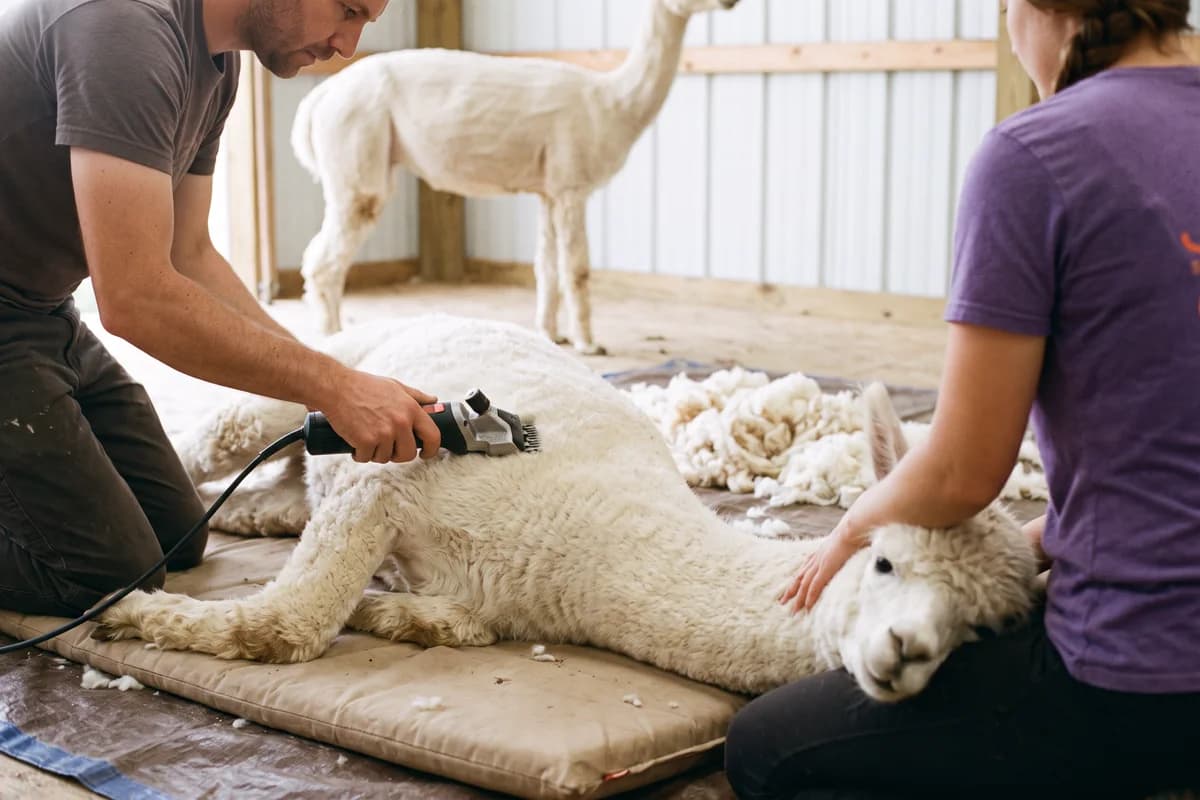
Some routines can’t be avoided, but they can be done differently. The annual shearing, for example, demonstrably causes stress, measurable in the rise of the stress hormone cortisol in saliva and feces. How exactly the animal is held makes a difference: restraining an animal standing up is less stressful than laying it down or putting it on a tilt table.
For everyday practice that means: the method counts almost as much as the frequency. Anyone who relies on calm, choices and little coercion in handling lowers acute stress and makes the animal more cooperative the next time.
Alpacas as therapy animals: what the evidence really supports
Hardly any topic is linked to alpacas as often as animal-assisted therapy, and pictures of alpaca visits to care homes or schools circulate accordingly often. The scientific basis for it is thin, though. At its core there is essentially one single older, peer-reviewed study, which observed more language use and more social interaction in children with autism during alpaca contact. Reliable cortisol or long-term data that would support a real therapeutic effect in camelids are largely missing so far.
On top of that: not every animal is suited to this work. Field reports, which should be classed as anecdotal, speak of only about one in 15 llamas and one in 75 alpacas having the self-confidence and calm needed for contact with strangers in unfamiliar situations. Anyone who wants to use alpacas for therapeutic or educational purposes should do so with realistic expectations, and with the knowledge that research here is still at the beginning.
Frequently asked questions
How smart are alpacas compared to other animals?
In an A-not-B detour test with 51 alpacas, not a single animal made a perseveration error, that is, stubbornly sticking to a practiced route that has become wrong. Dogs, horses, donkeys and mules do clearly worse in the same test setup. That points to unusually good impulse control in alpacas.
Can llamas learn from humans?
Yes. In a study with 30 llamas, 7 out of 10 animals solved a detour task after a human had first shown them the solution. After a demonstration by another llama it was 6 out of 10, and with no demonstration at all only 2 out of 10. So llamas learn through pure observation, both from humans and from other llamas.
How do alpacas recognize each other?
By voice, among other things. Alpacas communicate a lot through a soft humming sound, the so-called hum, which carries an individual acoustic signature. A classifier that analyzed only the audio data assigned calls to the correct animal in 71 percent of cases.
How do you train alpacas properly?
Best with low-pressure, cooperative methods instead of force, for example following the Camelidynamics/TTEAM system. You should avoid treats, because hand-feeding disrupts the pecking order. A small catch pen and clicker training help animals take part voluntarily instead of being driven. Studies show that animals trained this way can be led significantly more easily.
Are alpacas suitable for animal-assisted therapy?
The evidence on this is weak. Essentially there is only one older study from 2006, which observed more language use and social interaction in children with autism. Reliable cortisol or long-term data are largely missing, and according to anecdotal field reports only about one in 75 alpacas and one in 15 llamas is suited to this work at all.
Sources
- Abramson et al., Animal Cognition (2018) — A-not-B-Umwegtest, Impulskontrolle bei 51 Alpakas
- Vasconcellos et al., Animal Cognition (2023) — Beobachtungslernen bei Lamas
- Windschnurer et al., Applied Animal Behaviour Science (2021) — druckarmes Handling und Training
- Individuelle Stimmerkennung anhand der „Hums“, Bioacoustics (2024)
- Sams, Fortney & Willenbring, American Journal of Occupational Therapy 60(3):268–274 (2006) — tiergestützte Ergotherapie bei Autismus
- Rappersberger, „Lamas und Alpakas — Haltung, Zucht und Nutzungsformen“, 3. Auflage, Ulmer Verlag (2018), ISBN 978-3-8001-0768-1