Legal obligations
What you need to know legally as an alpaca or llama keeper in Germany
Registration, animal welfare, tax, insurance, transport — the complete overview of the legal requirements for keeping alpacas in Germany, in eight clear blocks.
As of 2026. This overview is not legal advice. Rules can differ between federal states — for detailed questions, contact your Veterinäramt (veterinary office) or a tax advisor who specializes in agriculture.
Applies to Germany: this overview describes German law. Laws, paragraphs and authority names are kept in German.
Registration
Before the first animal arrives on your farm, three authorities want to know that you keep alpacas or llamas — whether you have one animal or a hundred.
For hobby keepers
- Required
Veterinäramt: Notify the keeping of animals under § 26 Viehverkehrsverordnung (livestock movement ordinance). Applies from the first animal, even in a private garden.
- Required
Holding number (VVVO no.): Assigned by the Veterinäramt. You need it for every further notification.
- Required
Tierseuchenkasse (animal disease fund): Registration — whether you must report depends on the federal state. The fee is calculated per animal and year.
- Required
HIT database: Annual reporting-date notification on January 1 with your current number of animals.
Additionally for commercial keepers
- Required
Business registration: With the Ordnungsamt of the municipality.
- Required
Tax registration: With the Finanzamt (see block 8).
Identification
There is no nationwide identification requirement for New World camelids — breeding associations are much stricter than the legislator.
For hobby keepers
- Recommended
Ear tag or microchip: Makes the herd register, veterinary records and sales easier.
- Optional
Passport of the breeding association: Standard in reputable trade, a prerequisite for association breeding.
- Optional
DNA typing: Useful if offspring are later to enter the herd book.
For commercial keepers (sales, breeding)
- Recommended
Passport of the breeding association: A de facto requirement for every animal for sale — buyers ask for it.
- Required
DNA proof of parentage: Mandatory for a herd book entry — through the respective breeding association.
Husbandry and animal welfare
§ 2 Tierschutzgesetz (Animal Welfare Act) is the legal minimum. Anyone keeping animals long term should go well beyond it.
For all keepers (hobby & commercial)
- Required
Herd keeping: At least two animals of the same species. A horse, donkey or goat is no substitute for a companion of their own kind.
- Required
Minimum area: BMEL recommendation: about 1,000 m² for two animals, plus 100 m² for each additional animal. Breeding associations recommend up to 1,000 m² per animal.
- Required
Weather protection: A dry, draft-free shelter with enough lying space.
- Required
Water & hay: Freely available at all times.
- Required
Fence: Visible, without risk of injury, at least 1.20 m high.
- Required
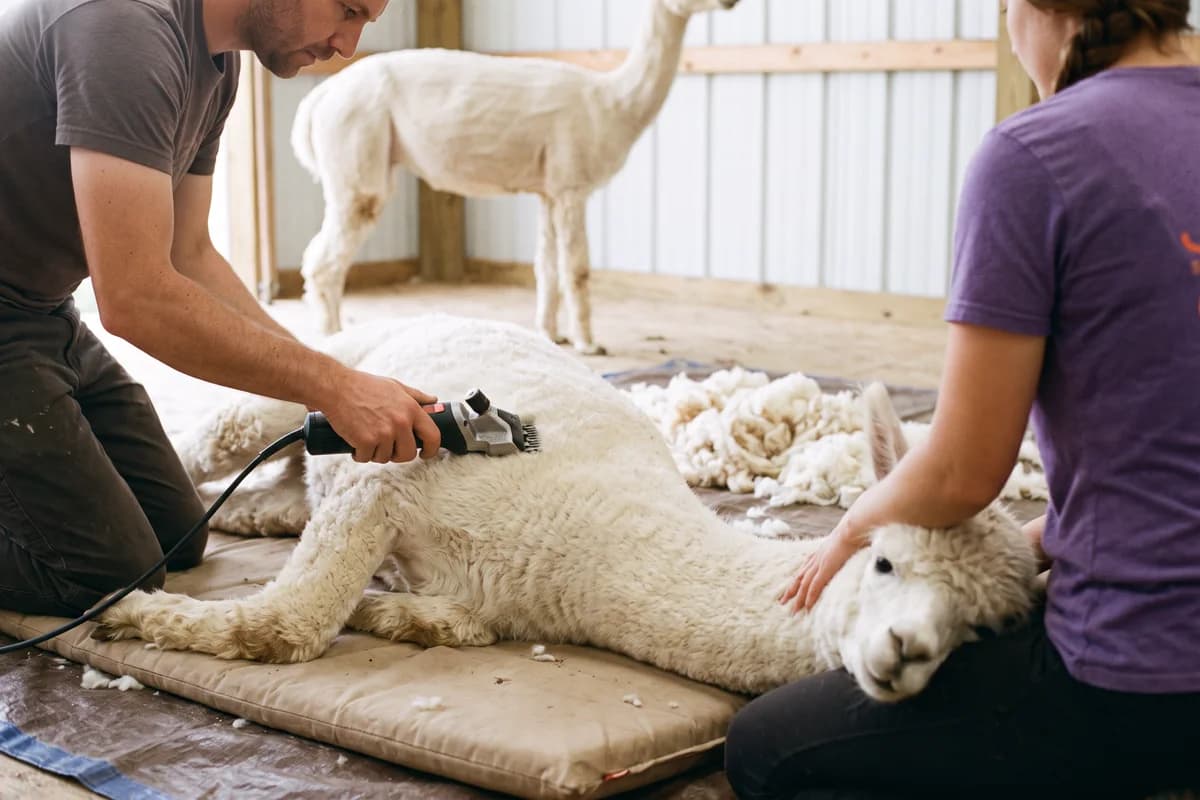
Annual shearing: Relevant for animal welfare from May/June — unshorn animals risk heatstroke.
Additionally for commercial keepers
- Required
Proof of expertise: Under § 11 TierSchG (see block 6).
- Recommended
Stable log / pasture rotation plan: As proof during inspections.
Mandatory documentation
In an animal welfare inspection, the first thing they ask for is paperwork. If you cannot show anything, you have a problem — even if the animals are kept perfectly.
For all keepers (hobby & commercial)
- Required
Herd register: Under § 45 VVVO: every arrival and departure with date, identification, origin and destination, plus the total number on January 1 of each year. All required details
- Required
Veterinary medicines record: Under TAMV: every treatment with active substance, dosage and withdrawal period. Legally, alpacas and llamas count as food-producing animals.
- Required
TAM database (HIT): Twice-yearly reporting of antibiotic treatments.
- Required
Retention: Herd register 3 years (the period runs from December 31 of the year of the last entry), medicine records 5 years. Both must be available at any time.
Additionally for commercial keepers
- Recommended
Pasture diary: With area rotation as proof of species-appropriate husbandry.
- Recommended
Trek logbook: With animal assignment for each tour.
Keep your herd register automatically in ALPAKA.PRO — 30 days free.
Try it freeInsurance and liability
The BGB says: the animal keeper is liable — regardless of fault. Insurance is not required, but the damage is real.
For hobby keepers
- Recommended
Animal keeper liability insurance: Specifically for grazing animals — from about €50 a year for several animals.
- Optional
Grazing animal insurance: For loss through illness, accident or theft.
- Optional
Animal life insurance: For breeding animals and high-value individual animals.
Additionally for commercial keepers
- Required
Commercial extension of the animal keeper liability insurance: The standard private version does not cover damage from walks and trekking.
- Recommended
Business liability insurance: For guests on the farm, webinar rooms, experience offers.
- Recommended
Contents insurance: For the barn, equipment, wool store.
Commercial use (walks, trekking, therapy)
As soon as money changes hands, it gets complicated. The moment you charge for a walk, your hobby becomes a business that requires a permit — and the Veterinäramt knows it.
For commercial keepers (walks, trekking, therapy)
- Required
Permit under § 11 TierSchG: From the responsible Landratsamt — before your first offer.
- Required
Proof of expertise: Under § 11 para. 1 no. 8a–d TierSchG: training and examination at the Veterinäramt.
- Required
Proof of reliability: Police clearance certificate and an extract from the central trade register.
- Required
Suitability of facilities: On-site inspection of barn, run, routes and rest areas.
- Required
Business registration: With the Ordnungsamt of the municipality.
- Required
Tax registration: With the Finanzamt (see block 8).
- Recommended
Behavior assessment (therapy/accompaniment): For therapy and companion alpacas.
- Recommended
Insurance clause (therapy): For therapeutic accompaniment.
Transport
As soon as the trailer leaves the farm, EU rules apply. Even on a 20-minute trip to the neighboring pasture.
For hobby keepers (own animals, non-commercial)
- Optional
Private transports under 50 km: Largely exempt without an economic purpose — § 2 TierSchG still applies.
- Recommended
Suitable trailer: With a non-slip floor, sufficient height and ventilation.
For commercial keepers
- Required
Certificate of competence type 1: For transports of up to 8 hours — training through DEULA, BLAK or the Landwirtschaftskammer.
- Required
Certificate of competence type 2: For transports of more than 8 hours.
- Required
Authorization as a transport company: Through the Veterinäramt.
- Required
Compliance with EU-VO 1/2005: Minimum dimensions, breaks, temperature, maximum transport duration.
- Required
Transport documentation: With date, route and number of animals.
Tax and the Finanzamt (tax office)
Agriculture and forestry, business or hobby? The tax classification decides whether you may deduct losses — or whether the Finanzamt retroactively withdraws its recognition.
For hobby keepers
- Optional
Status: hobby activity (usual case): No intention to make a profit, no loss deduction, but no tax liability either.
- Recommended
Watch out for side income: Selling wool or hay, or charging stud fees, is relevant for tax as soon as it happens regularly.
For commercial keepers and breeders
- Required
Status: agriculture and forestry (LuF): For breeding and keeping with the intention to make a profit — documentation required.
- Required
Status: business: For walks, trekking, online shop and courses.
- Required
Intention to make a profit provable: Business plan, calculation, market study.
- Required
Start-up phase: Losses are recognized for 8–10 years (FG Münster, 4 K 1666/17 E) — after that the Finanzamt expects to see profits.
- Optional
Flat-rate VAT: For LuF businesses — simplifies bookkeeping.
Optional · Special cases
Special cases
Most keepers need blocks 1–8. Anyone who imports, slaughters or breeds internationally needs specialist knowledge.
Import, slaughter, international breeding
- Required
TRACES entry: For imports from third countries (Chile, Peru, Bolivia) via an authorized border control post.
- Required
Veterinary certificate & GGED: Accompanies every import.
- Required
Quarantine: 30–90 days depending on the country of origin.
- Required
Entry as a food-producing animal (HIT): For slaughter and use as food.
- Required
Document withdrawal periods: To be observed for all veterinary medicines before slaughter.
- Required
Slaughterhouse with EU approval: On-farm slaughter is only permitted in exceptional cases.
- Required
EU veterinary certificates: For international embryo and semen transfers.
- Recommended
Association certification: For recognition in the herd book in international breeding.
Frequently asked questions
Which authorities do I have to inform as an alpaca or llama keeper?
Three bodies are mandatory: the Veterinäramt (notification under § 26 Viehverkehrsverordnung), the Tierseuchenkasse (depending on the federal state) and the HIT database (reporting-date notification on January 1 of each year). The Veterinäramt assigns a holding number (VVVO no.), which is a prerequisite for all further notifications.
Do I need a permit for alpaca walks?
Yes. As soon as money changes hands — even on a donation basis — a permit under § 11 TierSchG from the responsible Landratsamt is mandatory. Requirements are proof of expertise, proof of reliability (police clearance certificate), suitability of the facilities, as well as business registration and tax registration. From application to permit takes 3–6 months.
Which books and registers do I have to keep as a keeper?
Mandatory are the herd register under § 45 VVVO (arrivals and departures and the total number on January 1), the veterinary medicines record under TAMV (treatments, active substances, withdrawal periods) and the twice-yearly antibiotics report in the TAM database (HIT). Retention: 3 years for the herd register, 5 years for the medicine records — available at any time.
How much space do alpacas and llamas need?
BMEL recommendation: about 1,000 m² for two animals, plus 100 m² for each additional animal. Breeding associations recommend up to 1,000 m² per animal. Herd keeping with at least two animals of the same species is mandatory — a horse, donkey or goat is no substitute for a companion of their own kind.
Do I need animal keeper liability insurance for alpacas and llamas?
In Germany, animal keeper liability insurance for alpacas and llamas is not required by law, but strongly recommended — the keeper is liable regardless of fault. For commercial use (walks, trekking), a commercial extension is a mandatory component, because the standard private version does not cover this damage.
Is keeping alpacas a hobby activity or agriculture and forestry?
Hobby keepers without an intention to make a profit are treated as a hobby activity (no tax liability, but no loss deduction either). Anyone who wants to make a profit from breeding and keeping falls under agriculture and forestry. Walks and trekking are a business. The FG Münster (4 K 1666/17 E) recognizes a start-up phase of 8–10 years with losses, provided the intention to make a profit is documented.