Sustainability
Is alpaca wool really sustainable? The honest life cycle assessment
Timm Quandt7 min read
“Is alpaca wool sustainable?” On labels and in shop copy, the answer is almost always yes, often wrapped in words like “sustainable natural fiber” or “climate-friendly”. It is rarely backed up with real numbers. I went through two peer-reviewed life cycle studies on alpaca fiber. They answer the question not with a sales slogan but with two very different views of the same raw material, and that is exactly where the catch lies.
0.449 kg CO₂: the footprint of a single wear
A 2023 study, published in the journal Science of the Total Environment, examined a sweater made of 100 percent Peruvian alpaca fiber across its entire life, from raw material extraction to disposal. In life cycle assessment, this approach is called cradle-to-grave. Instead of one value per sweater, the authors scaled the footprint down to a single use: 0.449 kg CO₂ equivalents per single wear. CO₂ equivalents are the standard unit in life cycle assessments: different greenhouse gases such as methane or nitrous oxide are converted into their climate impact compared with CO₂ and combined into a single value.
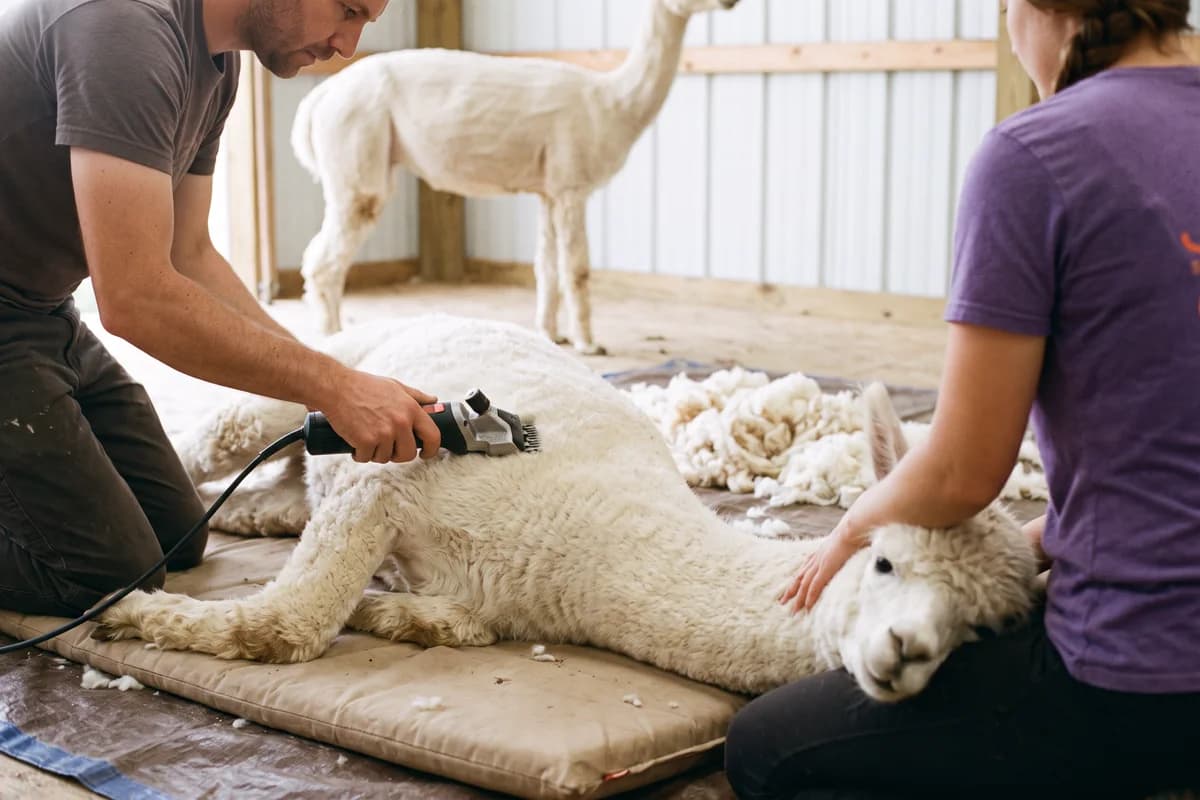
The distribution is interesting. At 70 percent, by far the largest share goes to fiber production, that is breeding and shearing of the animals. Distribution, that is transport and sales, accounts for 14 percent. All other phases together, from processing to disposal, make up the remaining 16 percent.
53 kg CO₂ per kilogram of fiber: the view from the farm
A second study, published in 2022 by Gómez-Quispe and colleagues in the journal Tropical Animal Health and Production, looks not at the finished sweater but at an extensive Peruvian Andean system up to the farm gate, that is cradle-to-farm-gate. The result: 53.0 kg CO₂ equivalents per kilogram of fiber, calculated using a biophysical allocation. That means the emissions are distributed between fiber and meat by biological effort rather than by market price. Relative to the animals’ live weight, that comes to 22.6 kg per kilogram.
The biggest driver here is not processing but digestion. Enteric fermentation, that is the methane produced in the animals’ stomachs during microbial digestion of roughage, accounts for 67 percent. On top of that come direct and indirect nitrous oxide emissions at 29 percent.
| Feature | 2023 study (sweater) | 2022 study (fiber from the farm) |
|---|---|---|
| System boundary | cradle-to-grave | cradle-to-farm-gate |
| Functional unit | one wear of the sweater | one kg of raw fiber |
| Result | 0.449 kg CO₂-eq | 53.0 kg CO₂-eq (22.6 kg per kg of live weight) |
| Biggest single driver | Fiber production, 70 % | Enteric fermentation, 67 % |
Why you must not calculate the two figures against each other
It is tempting to cook up some catchy metric out of 0.449 kg and 53 kg. Resist that. The two studies measure different things with different system boundaries and functional units: once “one wear of a finished sweater” over its entire life, once “one kilogram of raw fiber” up to the farm gate, before anything was even spun or sewn. You can’t divide one number by the other or add it to the other and construct a global average for alpaca wool from it.
It is also important that both figures come from a single study each on Peruvian systems. That is not a world average for alpaca keeping, and it says nothing about how a farm in Germany or Australia would fare. If you don’t find this caveat in a comparison table, be skeptical.
What both studies nonetheless agree on
Despite different system boundaries, both studies show the same pattern: the lion’s share of emissions arises on the farm, not in the spinning mill or in shipping. In the sweater study it is 70 percent for fiber production, in the farm-gate study 67 percent for the animals’ digestive methane alone. Processing and logistics each play a minor role.
This matches what is known from other animal-based natural fibers. With sheep’s wool and cashmere, too, the lever lies with the animal, not in the factory. Anyone who wants to improve the life cycle footprint of a natural fiber therefore has to start with husbandry, feeding and herd size, not just with the spinning process.
What is not (yet) proven
Two claims that circulate fairly often in connection with these studies do not hold up to closer scrutiny. The first: it is often sharpened to say that around 85 percent of the climate impact of the fiber phase comes from the animals’ digestive methane alone. This figure cannot be derived from the sweater study. All that can be substantiated is the 67 percent methane dominance from the separate farm-gate study, no more and no less.
The second open issue: a clean, methodologically consistent comparison of alpaca fiber against cashmere, merino wool and synthetic fibers, across land, water and CO2 together, does not yet exist in the reliable literature. Comparison tables that circulate online and present alpaca wool across the board as more climate-friendly than cashmere or polyester generally don’t rely on a common methodology. Read them with caution.
What this means for you
For the environmental footprint, this means: alpaca wool is not an emission-free fiber, even though it is natural, biodegradable and free of microplastics. Its CO2 footprint arises mostly at the animals themselves, much as with wool or cashmere. If you are looking for the most climate-friendly fiber of all, there is currently no credible, methodologically clean answer.
For breeders and keepers, this means: honest communication beats any unsubstantiated marketing claim. Instead of advertising with “climate neutral” or “more sustainable than X”, which simply cannot be derived from the studies available, it pays to point to what actually holds true: extensive pasture keeping, a responsibly managed herd and an end product without synthetic fibers.
Frequently asked questions
Is alpaca wool sustainable?
Alpaca wool has a real, measurable CO2 footprint, which arises mostly at the animals themselves, not in spinning or shipping. That makes it not an emission-free fiber, but it is natural, biodegradable and free of microplastics. A reliable comparison with other fibers such as cashmere or merino wool is still missing from the literature.
How big is the CO2 footprint of alpaca wool?
A 2023 study (Science of the Total Environment) puts the footprint of a sweater made of 100 percent Peruvian alpaca fiber at 0.449 kg CO2 equivalents per single wear. A second study from 2022 (Gómez-Quispe et al.) arrives at 53.0 kg CO2 equivalents per kilogram of raw fiber at the farm gate for a Peruvian Andean system. The two figures have different system boundaries and must not be calculated against each other.
Why does alpaca wool cause CO2 emissions?
The biggest driver is enteric fermentation, that is the methane produced in the animals’ stomachs during microbial digestion of roughage. According to the farm-gate study by Gómez-Quispe et al. (2022), it accounts for 67 percent of emissions, plus 29 percent from direct and indirect nitrous oxide emissions.
Is alpaca wool more climate-friendly than cashmere or merino wool?
That cannot be answered credibly from the studies available. A methodologically consistent comparison of alpaca fiber against cashmere, merino wool and synthetic fibers across land, water and CO2 does not yet exist in the reliable literature. Comparison tables that present alpaca wool across the board as more climate-friendly mostly don’t rely on a common methodology.
Where do most of the emissions of alpaca wool arise?
On the farm, not in processing. The 2023 sweater study attributes 70 percent of emissions to fiber production, and the 2022 farm-gate study locates 67 percent in the animals’ digestive methane. Both studies show independently of each other that the lever lies with the animal, as with most animal-based natural fibers.