Breeding & genetics
Alpaca colors: the palette and the breeding pitfalls
Timm Quandt9 min read
Hardly any other fiber animal comes in as many natural colors as the alpaca. That is a gift for natural-color breeding and, at the same time, a field full of pitfalls. Two color types carry a lethal factor, and a third often goes along with deafness. If you don’t know this, you plan pairings that can never work out on paper. This overview shows what matters.
One of the biggest color palettes there is
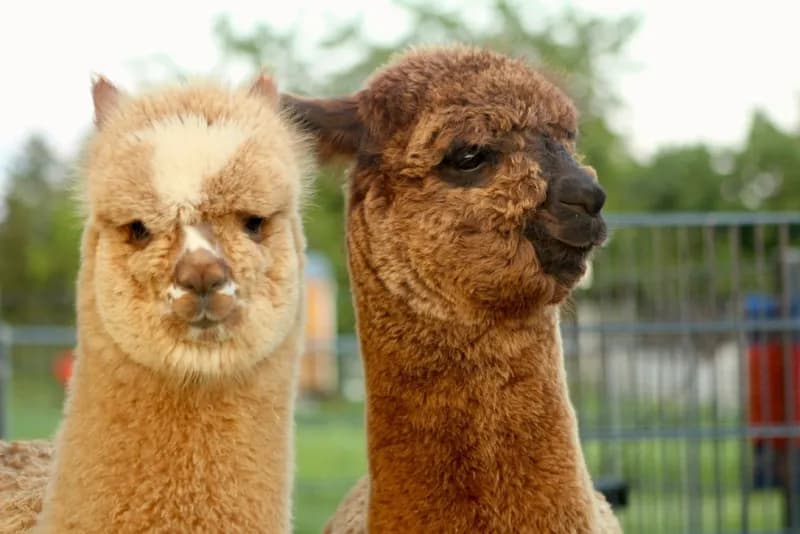
In Peru, over 52 natural shades are distinguished, and genetically there are even more than 300 nuances. For registration and shows, the Alpaca Owners Association boiled this down to 16 base colors, plus a few intermediate shades, 22 in total. The palette runs from white through beige and fawn shades, brown and gray gradations to bay black and true black. Every color carries an ARI code made of letters and a number, roughly from 100 (white) to 500 (black). (Alpaca Owners Association; AZVD)
| Color | Shade | ARI code |
|---|---|---|
| White | WH 100 | |
| Beige | BG 201 | |
| Light Fawn | LF 202 | |
| Medium Fawn | MF 204 | |
| Dark Fawn | DF 205 | |
| Light Brown | LB 209 | |
| Medium Brown | MB 301 | |
| Dark Brown | DB 410 | |
| Bay Black | BB 360 | |
| True Black | TB 500 | |
| Light Silver Grey | LSG 401 | |
| Medium Silver Grey | MSG 402 | |
| Dark Silver Grey | DSG 404 | |
| Light Rose Grey | LRG 408 | |
| Medium Rose Grey | MRG 211 | |
| Dark Rose Grey | DRG 306 |
The color swatches are approximate values for illustration, there is no official hex standard. On top of that come multicolored animals (Multicolour, MC 600), which can’t be assigned to a single color.
Color says nothing about fineness
A stubborn misconception: that white animals automatically have finer wool or black ones coarser. That isn’t true. Coat color is controlled by the genes ASIP and MC1R, while fiber diameter is controlled by entirely different genes, such as keratin genes like KRTAP7-1. The two systems work independently of each other. So you can have fine black and coarse white animals, and color is no indication of quality. (Alpaca genetics studies)
How fine an animal’s wool really is and how it’s measured is covered in the article Alpaca Wool: Why the Fiber Is So Special.
Classic Grey: the hidden lethal factor
Gray alpacas are popular and in demand accordingly. Behind the classic gray (“Classic Grey”), however, lies a confirmed lethal factor, not a breeder’s myth but a proven fact. The responsible mutation is inherited autosomal dominant and is lethal already in the embryo in the homozygous state, that is, when an animal receives it from both parents.
In practice that means: if you breed gray to gray, about a quarter of the embryos are lost early. Instead of the expected three quarters gray, you are left with only about two thirds gray and one third solid-colored offspring. Anyone who doesn’t know this wonders about the seemingly small litters. The good news: there is a commercial genetic test (University of Giessen, VHLGenetics) that can identify carriers in advance. Silver gray and rose gray, by the way, arise differently, through so-called roaning, and don’t carry this risk in the same way. (Animal Frontiers 2022)
Blue-eyed and pure white? Look closer
A blue-eyed white alpaca (BEW for short) looks spectacular. Behind it is presumably the combination of the gray gene with a white spotting gene. The catch: such animals are very likely born deaf, in 70 to 90 percent of cases in both ears depending on the study, just like white cats with blue eyes. Deaf animals can be kept, but you should know about it, for their safety, for training and for the decision whether to deliberately keep breeding for BEW. (BAER studies; J Heredity 2014)
Suri or Huacaya is inherited too
Not only color, but the fleece type as well follows clear rules. Suri is inherited autosomal dominant, Huacaya recessive. The cause is a mutation in the TRPV3 gene, which was found in all Suri animals examined. There is even a suspicion that the Suri gene might also be lethal in the homozygous state. That hasn’t been proven yet, but it would explain why the Suri share has been stuck at around seven percent for decades. (BMC Genomics 2024)
For spotting patterns, that is tuxedo, appaloosa and pinto, the genetics are not yet understood. Comparisons with the horse don’t help much here. Anyone breeding for patterns therefore still works with experience rather than a genetic test. (Animal Frontiers 2022)
What this means for your breeding
For a long time, breeders focused mainly on pure white animals, because white wool can be dyed any color. With the trend toward natural colors, that has flipped. Today in Europe, healthy dark color types are often easier to find than flawless sires of lots of white wool. Which color you aim for in your breeding remains a matter of taste, and you now know the genetic traps.
One last point that weighs more than any color: the gene pool. Around 99 percent of all alpacas still live in South America, and the herds elsewhere trace back to a few imported animals. Relatedness is correspondingly close, and alpacas show signs of recent inbreeding. Outcrossing and a properly maintained pedigree are therefore not optional extras but the foundation of healthy breeding. (BMC Genomics 2023)
How mating timing, gestation and birth fit together is covered in the article The Mating Process in Alpacas.
Frequently asked questions
How many colors do alpacas come in?
In Peru, over 52 natural shades are distinguished, and genetically there are more than 300 nuances. For registration and shows, the Alpaca Owners Association lists 16 base colors plus a few intermediate shades, 22 in total.
Are white, blue-eyed alpacas deaf?
Very likely, yes. Pure white, blue-eyed alpacas (blue-eyed white, BEW) are, depending on the study, about 70 to 90 percent congenitally deaf in both ears, much like white cats with blue eyes. This should be taken into account in breeding plans.
What is the Classic Grey lethal factor in alpacas?
Classic Grey is inherited autosomal dominant and is embryonically lethal in the homozygous state. When you breed gray to gray, you therefore get about two thirds gray and one third solid-colored offspring instead of three quarters gray. A commercial genetic test exists.
Is coat color related to wool quality?
No. In alpacas, coat color and fiber fineness are controlled by independent gene systems. Color is therefore not a reliable indicator of how fine an animal’s wool is.
Sources
- Farbgenetik beim Alpaka, BMC Genomics (2024)
- Fellfarben und Zucht, Animal Frontiers (2022)
- Farbvererbung bei Neuweltkameliden, Journal of Heredity (2014)
- Genetische Grundlagen der Fellfarbe, Frontiers in Genetics (2019)
- Alpaca Owners Association (AOA) / Alpaca Registry (ARI) — Farbklassen und ARI-Codes