Fiber & wool
Alpaca wool: why the fiber is so special
Timm Quandt8 min read
Alpaca wool has a reputation: soft, light, warmer than anything else and skin-friendly on top of that. A lot of that is true, some of it is marketing. This article separates the two. You’ll learn what the fiber can really do, how to tell good quality from mediocre, and where the usual warmth claims go too far.
What makes alpaca wool special
Three properties explain most of the hype. The fiber is fine, it contains no wool grease, and it insulates well at low weight. A single alpaca produces about 2.3 to 4.5 kg of fiber a year. Top animals reach around 7 kg of total fleece, of which about 3 kg is usable in good quality. Peru, the country of origin, produces roughly 5,000 metric tons of alpaca fiber a year. (Wikipedia “Alpaca fiber”; industry association figures)
Fineness is a matter of microns
How soft a fiber feels depends mainly on its diameter, measured in micrometers (µm). The thinner it is, the softer it feels and the less it itches. It is measured objectively with an instrument (OFDA), not by feel. Rough fineness grades have become established in the trade:
| Grade | Diameter | Suitable for |
|---|---|---|
| Royal / Ultrafine | under 19 µm | directly on the skin, finest pieces |
| Baby / Superfine | 20 to 23 µm | scarves, fine sweaters |
| Fine | 23 to 26 µm | knitwear |
| Medium | 26 to 29 µm | outerwear, blankets |
| Strong | over 32 µm | felt, rugs |
From around 25 to 30 µm, the fiber develops a medullary canal, turns straight and starts to itch. From there on it is better suited to felting than to knitting. One important point for breeders: fineness declines with age. A young animal produces its finest fleece, after which the fiber gets a little coarser year after year. (NEAFP; LFI brochure 2020)
Huacaya or Suri
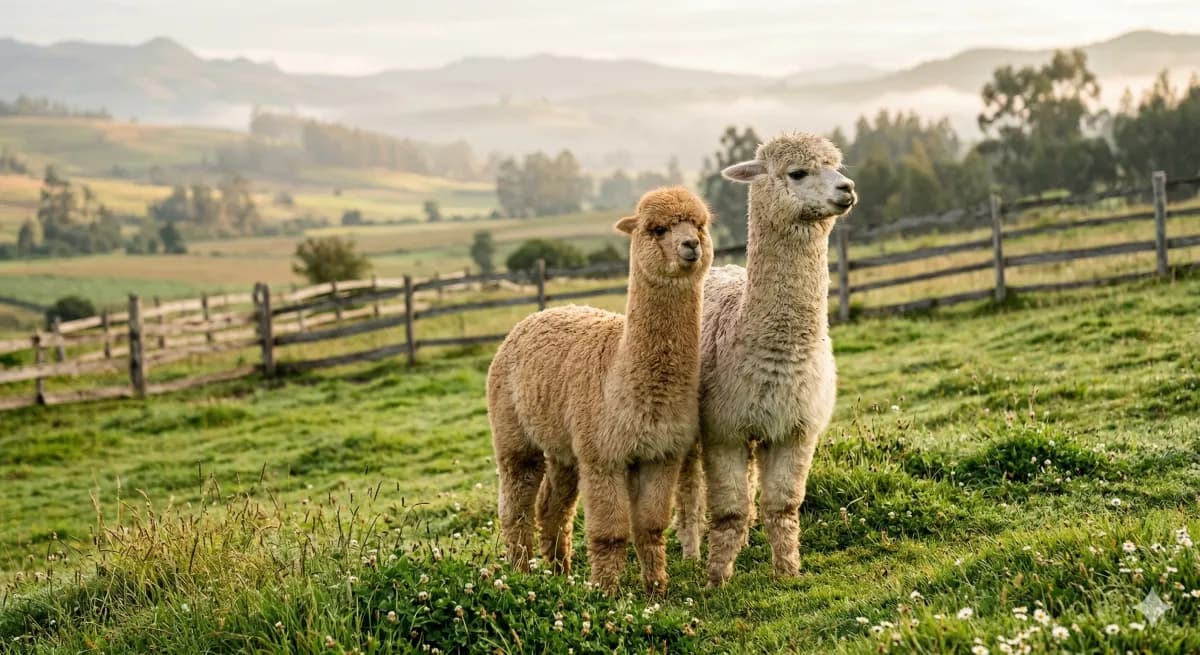
There are two fleece types. The Huacaya is the classic: strongly crimped, standing away from the body and giving the animal its plush look. Over 90 percent of all alpacas worldwide are Huacayas. The Suri is rarer, only about 7 percent, and looks completely different. The fiber doesn’t crimp but hangs down in smooth, glossy locks, almost like dreadlocks.
In numbers: Huacaya fiber averages 22.95 µm with strong crimp (45 °/mm) and a staple length of around 70 mm. Suri is slightly coarser at 24.71 µm, but glossier, barely crimped (17 °/mm) and much longer in staple at 120 mm. Suri also grows back faster, 12 to 20 cm a year compared to 8 to 13 cm for Huacaya. (Frontiers in Animal Science 2023; Pinares fiber study)
Hypoallergenic because there’s no lanolin
Sheep wool contains lanolin, a wool grease that many people react to with itching. Alpaca fiber gets by with practically none of this wool grease. That is the main reason it is considered hypoallergenic and can be worn directly on the skin by many people. On top of that comes the scale layer: at around 0.4 µm it is flatter than the roughly 0.8 µm of sheep wool, which explains the softer feel and the reduced itching. (Wikipedia “Alpaca fiber”; SEM measurements)
One detail that is often claimed wrongly: despite the smoother scales, alpaca does not felt less than sheep wool. In lab tests it even felted slightly more. So “softer and less itchy” is correct, “hardly felts” is not. (Liu & Wang 2007, Textile Research Journal)
Does it really keep you that much warmer?
This is where the trade exaggerates the most. Some of the fibers are medullated, meaning they contain an air-filled canal that insulates. In the only clean comparison measurement, alpaca fleece did keep warmer than merino sheep wool, by around 20 percent. That is a real, measurable advantage. (Soroko et al. 2019, Veterinarski arhiv)
What you should read with caution, on the other hand: claims like “30 percent warmer” or “seven times warmer than sheep wool”. There is no evidence for those. The real advantage lies more in the fiber being lighter at the same warmth and feeling drier. At about 8 percent, it absorbs only half as much moisture as sheep wool and wicks it outward. (Textile fiber data)
From fleece to yarn
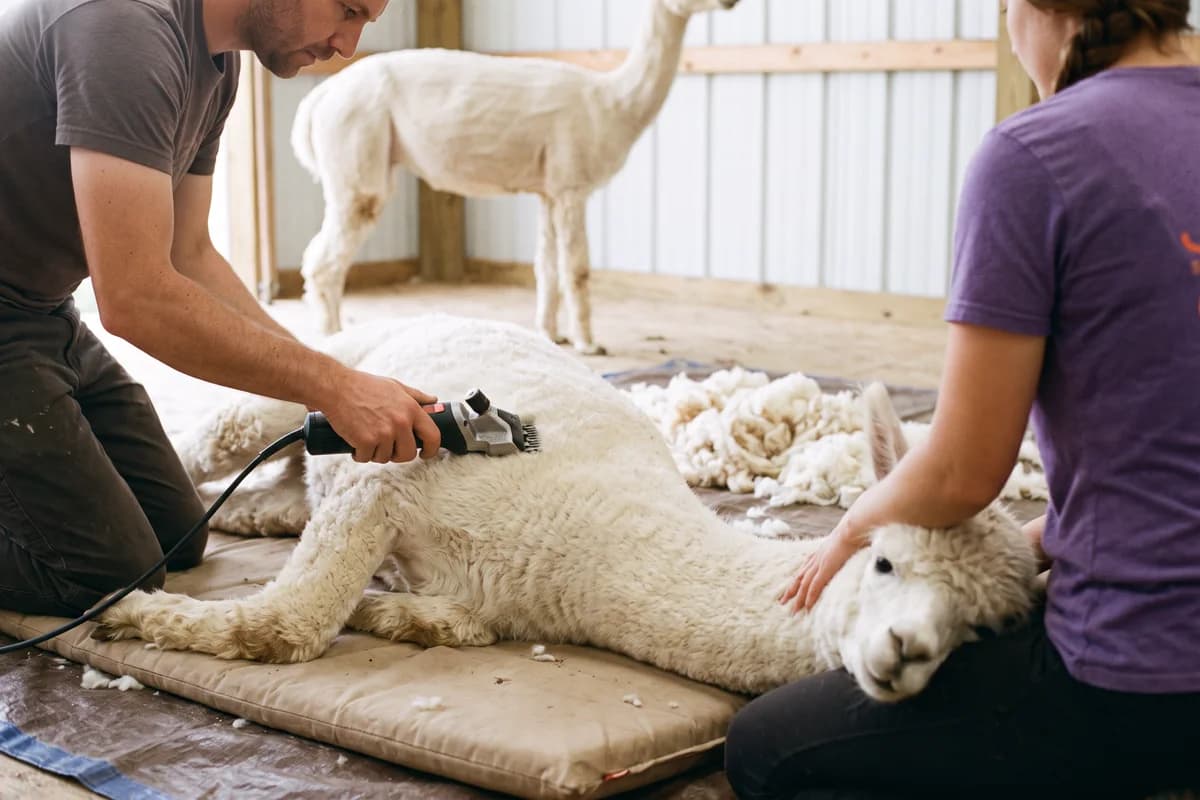
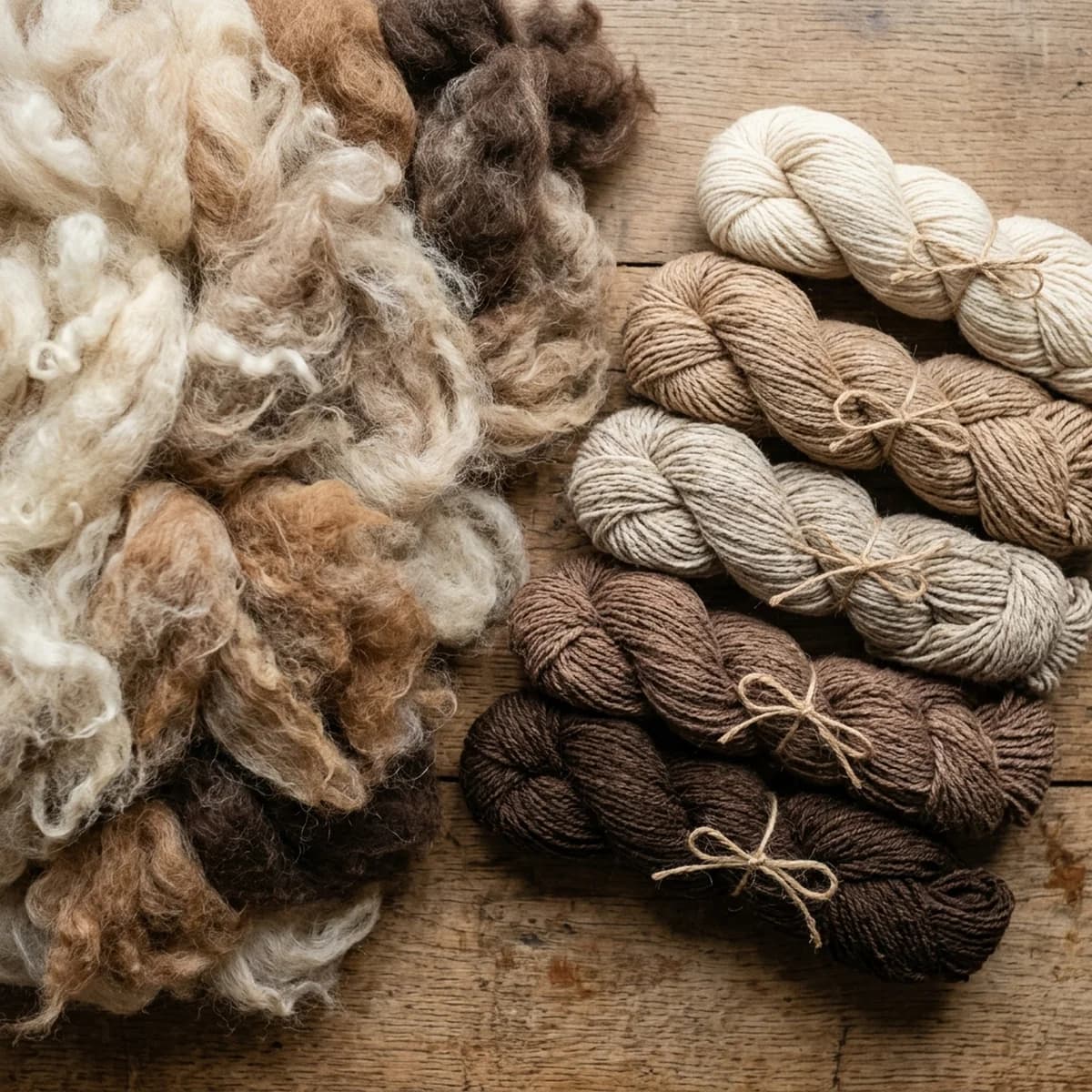
Not every part of the animal yields the same quality. The best piece is the “blanket”, the fiber over the back and flanks. It is the finest and most even. Neck and thighs are second grade, belly and lower legs the coarsest third grade. After shearing, the blanket is cleaned by hand, which is called “skirting”: guard hair and plant debris come out so that only the fine fiber is left. For further processing, a staple length of 5 to 15 cm is ideal. Anything shorter can only be felted, anything longer has to be cut beforehand. (NEAFP; Alpacas of Montana; LFI brochure 2020)
Everyday care
Because there is no wool grease in it and the fiber tends to release moisture, alpaca wool is easier to care for than you might think. Airing it out is often enough instead of washing. If you do wash it, do so cool, by hand, with wool detergent and without wringing, because the fiber is delicate when wet. Dry it lying flat, not hanging, or the piece will stretch out of shape.
By the way: the color of a fleece says nothing about its fineness. The two are inherited independently of each other. Why that is so, you can read in the article Alpaca Colors: Palette and Breeding Pitfalls.
Frequently asked questions
Is alpaca wool really hypoallergenic?
Unlike sheep wool, alpaca fiber contains practically no lanolin (wool grease). It is exactly this wool grease that triggers the reaction to sheep wool in many people. That is why alpaca wool is considered hypoallergenic, and it also itches less because its scale layer is flatter.
What is the difference between Huacaya and Suri?
Huacaya fleece is crimped and stands away from the body, looking voluminous and plush. Suri fleece hangs down in smooth, glossy locks. Huacaya makes up over 90 percent of the world population, while Suri is rare at around 7 percent and yields a particularly lustrous fiber.
Is alpaca wool warmer than sheep wool?
In the only clean comparison study, alpaca fleece insulated around 20 percent better than merino sheep wool. Common marketing claims such as “30 percent warmer” or “seven times warmer than sheep wool”, on the other hand, are not backed up.
How much wool does an alpaca give per year?
At the annual spring shearing, about 2.3 to 4.5 kg of fiber. Top animals produce up to 7 kg of total fleece, of which around 3 kg is usable in good quality.
Sources
- Kuźnicka et al., Archives Animal Breeding (2024) — Faserfeinheit und Vlieseigenschaften beim Alpaka
- Soroko et al., Veterinarski arhiv (2019) — Eigenschaften der Alpakafaser
- Liu & Wang, Textile Research Journal (2007) — Wärmeisolation im Faservergleich