Animal facts
Alpaca vs llama: the key differences
Timm Quandt7 min read
From a distance, alpacas and llamas look almost the same. Both fluffy, both with a long neck and a friendly face, both from the Andes. Up close, though, the difference between an alpaca and a llama is easy to spot. Usually a glance at the ears is enough. The rest comes down to size, wool and what you keep the animals for in the first place. These six points really matter.
The quick comparison
If you’re in a hurry, you’ll find the key points in this table. Below it, I go through each one individually.
| Trait | Alpaca | Llama |
|---|---|---|
| Ears | short, straight, pointed | long, curved inward |
| Weight | 48 to 90 kg | 130 to 270 kg |
| Height at the withers | approx. 90 cm | 100 to 115 cm |
| Main use | fine fiber and wool | pack and guard animal |
| Temperament | shyer, gentler | more confident, sturdier |
| Descended from | vicuña | guanaco |
The ears give it away right away
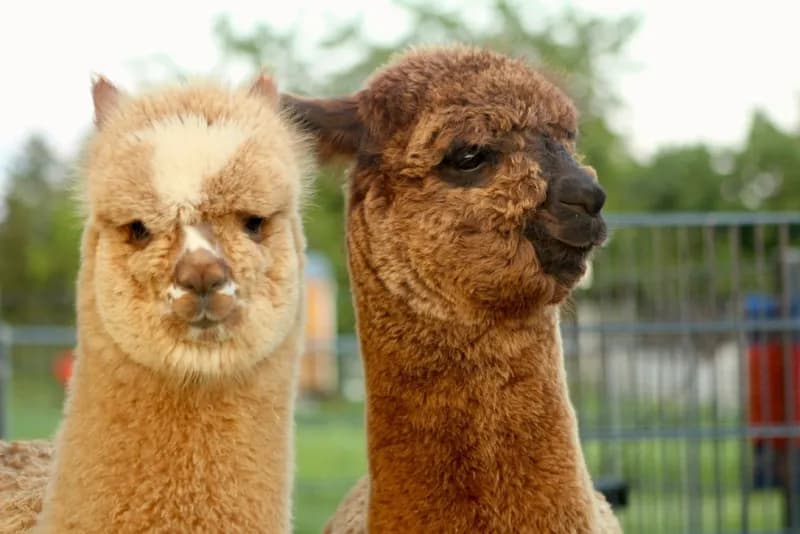
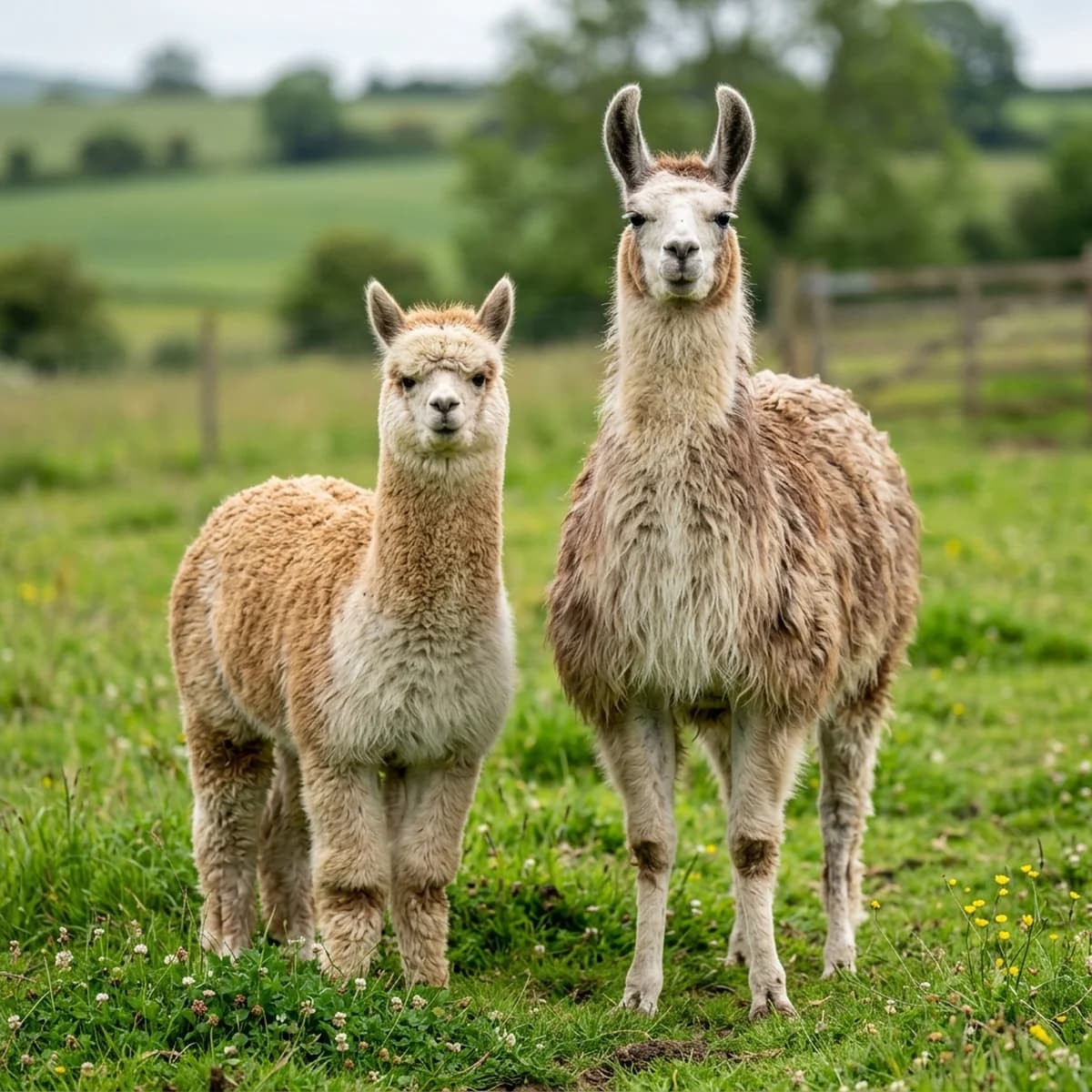
The clearest feature is on the head. Alpaca ears are short, straight and taper to a point, almost like little spears. Llama ears are longer and curve inward, which is why you often hear bananas used as a comparison. If you remember only one thing, make it this: short straight ears mean alpaca, long curved ears mean llama. (Britannica; Rutgers NJAES)
Size and weight
The llama is the largest domesticated New World camelid. It weighs 130 to 270 kg and stands 100 to 115 cm at the withers, and with its head raised it reaches about 1.80 m. An alpaca stays much smaller, at 48 to 90 kg and around 90 cm at the shoulder. Put the two side by side and you don’t even need the ears to tell them apart. (Animal Diversity Web; Rutgers NJAES)
When it comes to life expectancy, the two are close. Alpacas usually live 15 to 20 years, and the oldest documented animal reached 28. Llamas live 15 to 25 years, some over 30. (Wikipedia)
What they’re kept for
This is where the paths part most clearly. The alpaca is a fiber producer. After thousands of years of breeding, it has almost completely lost its coarse guard hair. Its fiber averages around 22 µm, fine enough to wear directly on the skin. The llama, by contrast, has always been a pack and guard animal. Its fleece carries coarse guard hair of 35 to 60 µm on top of the fine undercoat and is more likely to be made into rugs, ropes or felt. (Rappersberger 2018)
As a pack animal, a llama carries roughly a quarter to a third of its body weight over 8 to 13 km a day. As livestock protection, it is surprisingly good. A single gelded male or an unbred female will place itself between the herd and an intruder when danger appears, sound the alarm and move toward the threat. Against coyotes, foxes and stray dogs, that works reliably. Against bears or a whole pack, it doesn’t. (Wikipedia “Guard llama”; Iowa State Extension)
For more on the fiber itself, that is fineness, Huacaya vs Suri and why alpaca wool counts as hypoallergenic, see the article Alpaca Wool: Why the Fiber Is So Special.
Temperament and the matter of spitting
Both species are flight animals that keep their distance, not born cuddle animals. Alpacas are considered shyer and gentler, llamas more confident and curious. That also makes the llama the better guard animal. The best way to approach is calmly and from the side, without much eye contact and never directly from behind. (discover-bavaria; alpacainfo)
And the famous spitting? That happens mostly among the animals themselves, to settle the pecking order or in a fight over food. They rarely hit people, and mostly only when crowded. There is almost always a warning first: ears laid back and a raised nose. If you can read it, you stay dry. (Animal Diversity Web)
The right terms
In breeding, the animals have their own names, mostly from Spanish. A male is called a Macho, a female a Hembra. A gelded male is a gelding, a female not yet bred a maiden. The young animal is called a cria, Spanish for infant. (Alpacas of Montana)
Can you cross an alpaca and a llama?
Yes, you can. All New World camelids, that is alpaca, llama, vicuña and guanaco, have 74 chromosomes and can be crossed with each other. The cross between a llama sire and an alpaca dam is called a Huarizo (also Llapaca), and the first-generation animals are fertile. In serious fiber breeding, though, it hardly matters. If you want fine wool, you stick with pure alpaca. (Wikipedia “Huarizo”)
Myth check
Few animals have as many half-truths swirling around them. Four of them, set straight in brief:
- “They spit all the time.” No, almost only at each other. With people it happens only when crowded.
- “Alpacas are aggressive.” Quite the opposite. They avoid confrontation and are gentler than llamas.
- “They stink.” Hardly. The fleece contains no lanolin, so it smells little and is skin-friendly.
- “Alpacas are good swimmers.” Not really. Wet fleece quickly gets heavy, and they are not good swimmers. (Britannica)
One last number for your next bet: the most expensive alpaca of all time, the male “Snowmass Matrix”, changed hands in 2010 for 675,000 US dollars. (Guinness World Records)
Frequently asked questions
What is the difference between an alpaca and a llama?
The ears give it away fastest: alpaca ears are short, straight and pointed, llama ears long and curved inward. On top of that, a llama is much bigger at 130 to 270 kg than an alpaca at 48 to 90 kg. The alpaca is kept for its fine wool, the llama as a pack and guard animal.
Do alpacas and llamas spit at people?
Rarely. They mostly spit at each other, to settle the pecking order or defend food. A well-socialized animal hardly ever aims at people. Spitting is usually preceded by a clear warning: ears laid back and the nose raised high.
Can you cross an alpaca and a llama?
Yes. All New World camelids have 74 chromosomes and can be crossed with each other. The cross between a llama sire and an alpaca dam is called a Huarizo. The first-generation animals are fertile.
Can alpacas and llamas be kept together?
Yes. Both are herd animals and are often kept together. A llama can even guard a group of alpacas and defend it against canines.
Sources
- Kadwell et al., Proceedings of the Royal Society B (2001) — Abstammung: Alpaka vom Vikunja, Lama vom Guanako
- Kameliden-Genom, Genome Biology (2020)
- Merck Veterinary Manual — Anatomie, Verhalten und Fachbegriffe der Neuweltkameliden