Working animals & herd
Guard llamas: how llamas protect sheep and goat herds from predators
Timm Quandt7 min read
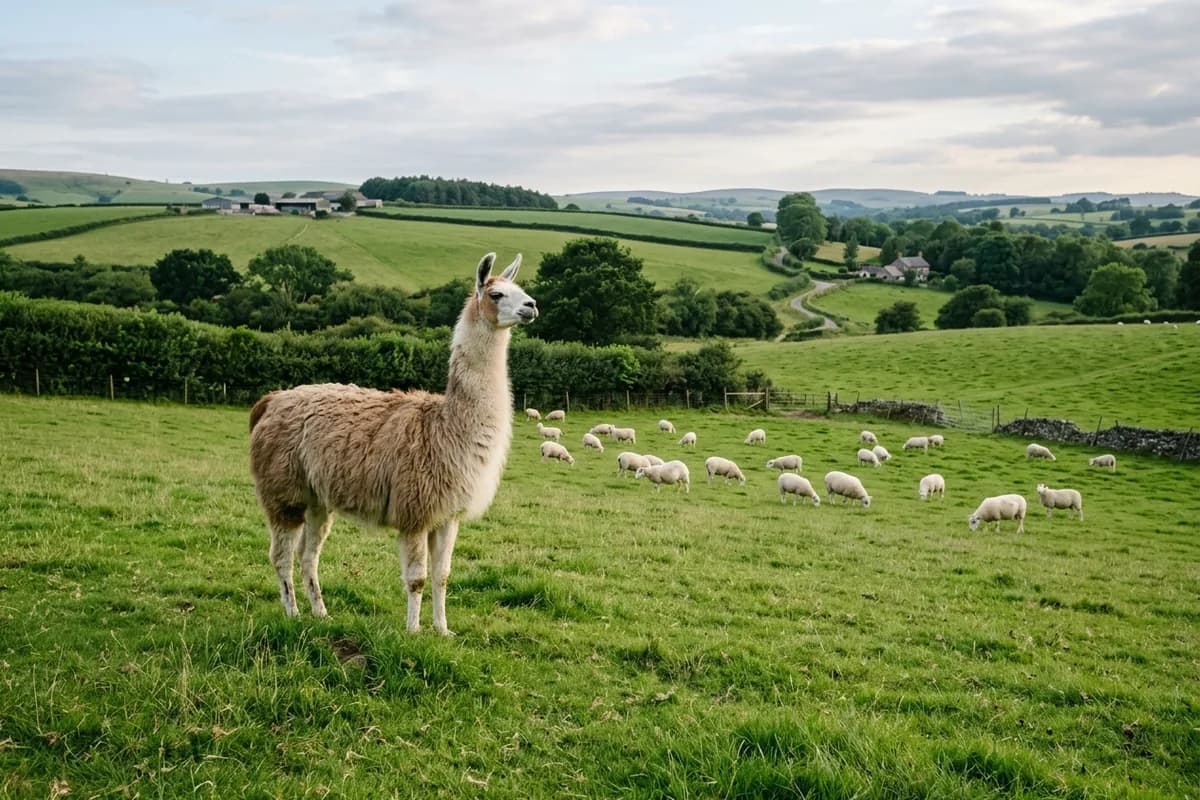
On many American sheep and goat pastures, a single llama stands next to the flock. No dog, no electric fence, just one large, watchful animal. That sounds like a makeshift solution at first, but it has been studied scientifically since the 1990s. How well guard llamas really keep predators away, who they help against and what matters when choosing one is covered in this article, including an honest comparison with the livestock guardian dog.
What the Iowa State study shows
The most important source of data on the subject comes from Iowa State University. In a 1990 survey, 80 percent of keepers rated their guard llamas as effective. The second figure is even more telling: average losses to predators on the surveyed farms dropped from 22 to 8 percent. That is not an anecdotal one-off observation but a broad survey of practitioners who actually work with guard llamas.
What stands out is that a single, unremarkable animal makes the difference here. No additional fence, no night watch, no technology, just a llama standing in the same pasture as the sheep or goats and following its natural instincts.
How reliable is the protection, really?
Within the guard llama literature, the effect is broken down in more detail, into three groups of animals.
| Effect | Share of guard llamas |
|---|---|
| Losses prevented completely | over 50 % |
| Losses reduced significantly | around 40 to 45 % |
| No measurable effect | around 5 to 10 % |
For the great majority of the animals in use, the effort pays off. A small remainder of llamas just don’t make good guards. That is true of any animal with a character of its own, and it is hard to predict reliably in advance.
Who guard llamas help against, and who they don’t
Guard llamas are specialists, not an all-purpose weapon. They work mainly against canines, that is coyotes, foxes and stray dogs. That covers a large share of the real attacks on small livestock herds. Against large predators such as bears or pumas, however, guard llamas are useless, and so they are against whole packs. A single llama, no matter how brave, has no chance against several coordinated attackers or a much larger predator.
In practice this means: if you know that foxes, stray dogs or, in North America, coyotes are the main problem in your region, a guard llama gives you solid, inexpensive protection. Where larger predators are on the move, additional measures are needed, and one llama alone is not enough.
How a llama defends the herd
When an intruder approaches, a good guard llama responds in a fixed sequence. First comes a shrill alarm call, often compared to a rusty door hinge, which carries far across the pasture. Then the animal runs straight toward the threat instead of fleeing, and uses kicks, bites or well-aimed spitting. In the end it positions itself between the intruder and the herd and holds that position until the danger has passed. This is not a trained trick but an expression of the natural territorial and herd behavior of llamas.
What is unusual above all is the direction in which the llama reacts. Sheep and goats are flight animals, and they scatter when danger comes. A llama runs toward the threat instead. This very difference in behavior is what makes it a guard in the first place, and not just a follower in the herd.
One animal, gelded: the right setup
When choosing, details decide between success and failure. A single llama per herd works best. If you put several male animals in together, they bond with each other instead of with the sheep or goats, and the protective effect almost completely evaporates.
Two setups have proved their worth: a castrated male, that is a gelding, from about two years of age, or a female that has not been bred yet, a maiden. Intact stud males, on the other hand, are considered dangerous. They try to mount ewes and can injure them in the process. That is why a future guard llama has to be castrated months before it is actually deployed, so that the breeding drive truly fades and is not just suppressed on the surface. More recent observations suggest, by the way, that unbred females may make the best guards, but this has not yet been conclusively proven.
For more on terms such as gelding, maiden and stud male, and on how llamas and alpacas otherwise differ, see the article Alpaca vs Llama: The Key Differences.
Llama or livestock guardian dog?
The livestock guardian dog is the established alternative, and a direct comparison shows where the limits of the guard llama lie. In a 2020 study by Saitone and colleagues, five livestock guardian dogs on a farm with 500 sheep significantly reduced losses. Economically it still didn’t pay off: calculated over seven years, the costs exceeded the benefits by 13,413 US dollars. The big advantage of the dogs remains their broader range of use. They also work against bears and pumas, where the llama is powerless.
In central Europe, using llamas for herd protection is still new. In Austria, for example, llamas, more rarely alpacas, are used alongside fences and livestock guardian dogs to protect sheep and poultry. Their size and alertness already keep many predators at a distance. Reliable long-term data for the German-speaking region is still scarce, though, and the practice is currently being followed scientifically.
Incidentally: the llama as a pack animal
Guard duty is not the only job a llama takes on. Classically, it is also the pack animal of the Andes and carries about 25 to 30 percent of its body weight over 8 to 13 kilometers a day. Guard animal and pack animal are not mutually exclusive, and both are roles that suit the robust, confident nature of the llama well.
Frequently asked questions
How effective are guard llamas against predators?
In a 1990 survey by Iowa State University, 80 percent of keepers rated their guard llamas as effective. Average losses to predators dropped from 22 to 8 percent. More than half of the llamas in use prevent losses completely, another 40 to 45 percent reduce them significantly, and only 5 to 10 percent show no measurable effect.
Which predators do guard llamas not help against?
Guard llamas work mainly against canines such as coyotes, foxes and stray dogs. Against large predators such as bears or pumas they are useless, and so they are against whole packs. Threats like these call for other or additional protective measures.
How many guard llamas should you use per herd?
Ideally exactly one. If you put several male llamas in together, they bond with each other instead of with the sheep or goat herd, and most of the protective effect is lost.
Does a guard llama have to be gelded?
A gelding (a castrated male) from about two years of age is considered the proven choice, and so is a female that has not been bred yet. Intact stud males are considered dangerous because they try to mount ewes and can injure them in the process. The castration therefore has to happen months before deployment so that the breeding drive really fades.
Are guard llamas cheaper than livestock guardian dogs?
Not necessarily. In a study by Saitone and colleagues (2020), five livestock guardian dogs on a farm with 500 sheep reduced losses significantly, but over seven years the costs exceeded the benefits by 13,413 US dollars. In return, guardian dogs cover a broader range of predators, including bears and pumas, where llamas are useless.
Sources
- Guard llama — Wikipedia, fasst die Iowa-State-University-Halterumfrage (1990) zusammen
- Saitone et al., Wildlife Society Bulletin (2020) — Kosten-Nutzen-Vergleich von Herdenschutzhunden
- Iowa State University Extension — Einsatz und Verhalten von Wachlamas