Husbandry & health
Keeping alpacas: the beginner’s guide
Timm Quandt10 min read
Alpacas have a reputation for being easy, and by and large that’s true. They are hardy, feed-efficient and, with their soft foot pads, even go easy on the pasture. Still, a few things need to be settled before you buy your first animals, from group size and acreage to the duty to register. This guide goes through them one by one.
Never alone: at least three animals
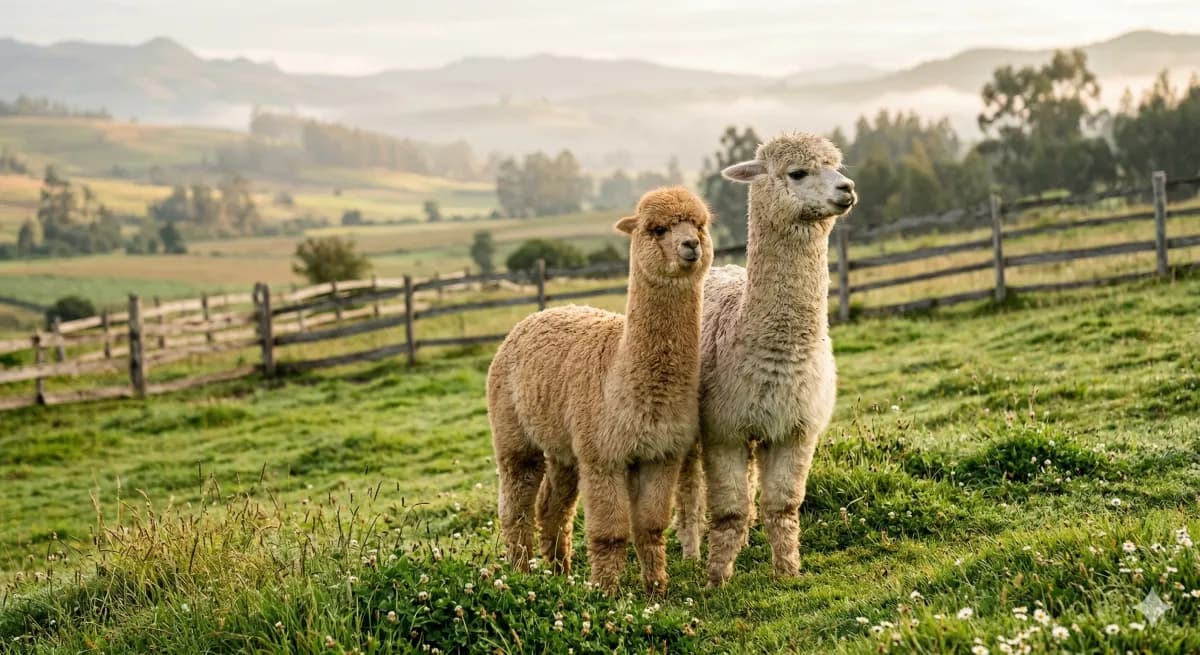
This is the most important point, and it is not negotiable. Alpacas are herd animals. A single animal gets lonely, stressed and sick. Keeping one alone is not permitted under German animal welfare law. Two animals are the absolute minimum, and at least three are recommended so that the herd still works if one animal drops out or is sold. (Alpaca UK; UC ANR)
How much space do you need?
In Germany, the BMEL minimum requirements (from the German Federal Ministry of Food and Agriculture) set the framework. For the first two animals you need at least 1,000 m² of pasture, plus 100 m² for each additional animal. The shelter should offer at least 4 m² for two animals, 1 m² more for each additional animal, with a clear height of at least 2 m. These are lower limits. More space is always better, if only because well-fed animals with plenty of choice won’t nibble on poisonous plants in the first place. (BMEL expert opinion)
When it comes to fencing, the animals themselves ask for little. Alpacas hardly test fences, and a height of around 1.20 m is enough. Barbed wire is out of the question. What matters more than height is often what comes in from outside, free-roaming dogs for example. The shelter doesn’t have to be heated, but it must be dry and protected from the wind, because soaked fleece loses its insulating effect. (UC ANR; Penn State)
What belongs on the menu
This is where beginners make the most mistakes, usually out of well-meant care. Alpacas are herbivores and live on roughage: grass and hay. Each day they take in about 1 to 2 percent of their body weight in dry matter, so an alpaca eats roughly 1 to 2 kg of hay. Their digestive system is built for sparse, high-fiber food and gets more out of it than a sheep or a cow. (NRC 2007; RMLA)
That is exactly why too much concentrate is dangerous. Feed rich in starch and sugar can make the first stomach compartment too acidic, so-called C1 acidosis, especially with a sudden change of feed. So introduce concentrate only in small amounts and slowly. Fresh water must always be available, and an alpaca drinks around 4 to 6 liters a day. (Tierärztliche Praxis, Thieme 2017; Veterian Key)
A word on weight: obesity is one of the most common health problems in kept alpacas, and the dense fleece hides it. Instead of judging by eye, you assess condition by hand using the body condition score (scale 1 to 5, the target is 3). Feeling over the back and loin once a month is enough to notice changes early. (Penn State Extension; Merck Vet Manual)
Minerals: vitamin D and selenium
Two points are especially important in our latitudes. In winter there isn’t enough UV light for the animals to make enough vitamin D themselves. Young animals in particular need a supplement from October to March, or they risk rickets. Vitamin D has to be dosed precisely, though, because an overdose is fatal. In addition, Germany is considered selenium-poor, which is why vitamin E and selenium supplementation is hard to avoid. It’s best to discuss both with your herd vet. (Camelid Veterinary Services; AZVD)
Routine care through the year
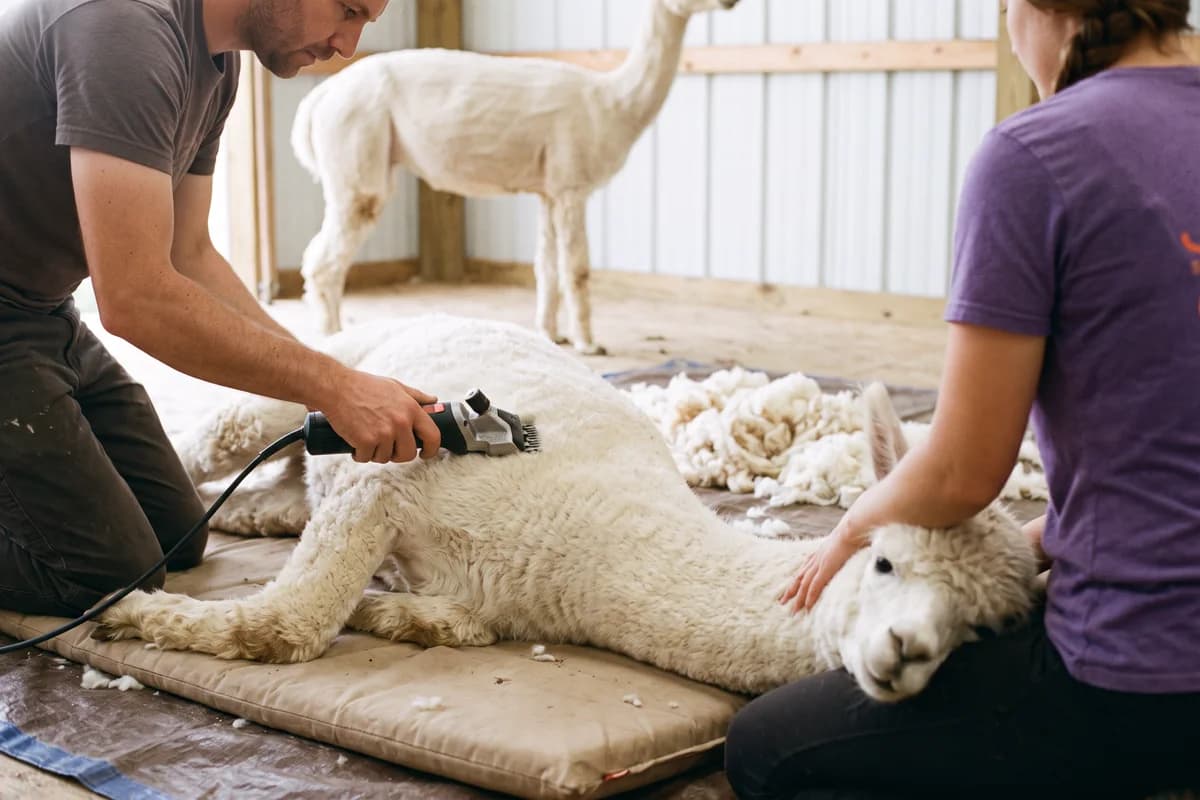
Four appointments make up the care calendar. Once a year, in spring, the animals are sheared. This isn’t about looks but about protection from heat: camelids tolerate heat and humidity poorly, and the fleece grows back by winter. The toenails are trimmed two to three times a year, depending on the ground. The teeth should be checked; in one study, 82 percent of the alpacas examined had at least one dental finding, and because the animals hardly show pain, it often goes unnoticed. In males, the sharp fighting teeth come on top, which are shortened regularly. (UC ANR; Proost et al. 2020)

Keeping an eye on health
The most common health issue is gastrointestinal parasites. Instead of deworming the whole herd by the calendar, which only promotes resistance, the approach today is targeted. Two tools help: a fecal test at least twice a year (spring and fall) and the FAMACHA method. With it, you read anemia directly from the color of the inner lower eyelid’s conjunctiva, on a scale from 1 (deep red, healthy) to 5 (white, severely anemic). Only animals that really need it are dewormed. (Tiergesundheitsdienst Burgenland; Veterian Key)
Vaccination is usually against clostridia (types C and D) and tetanus. A note that surprises many people: in Germany, no medicine and no vaccine is approved specifically for New World camelids, so the vet has to repurpose products from human medicine or from other animal species. That makes a vet with camelid experience all the more important. (Merck Vet Manual; AZVD)
Poisonous plants on the pasture and in neighboring gardens are a topic of their own. Which plants are dangerous for alpacas, and why some become even more toxic when dried in hay, is covered in the article Plants Poisonous to Alpacas.
What the law expects of you
There are three things you should know before your first animal. First: keeping alpacas must be registered, and you have to keep a herd register (Bestandsregister), as set out in § 45 of the Viehverkehrsverordnung (German livestock movement ordinance). There is no nationwide identification requirement (such as ear tags), but a microchip is recommended. Second, under § 833 of the BGB (German Civil Code) you are generally liable as an animal keeper for damage your animals cause, regardless of any fault of your own. Suitable animal keeper’s liability insurance is therefore part of the package. Third, in case you later offer walks or visits for money: as soon as money changes hands, it counts as commercial, and private liability insurance is no longer enough. (ViehVerkV; § 833 BGB)
The first step
Once you have land, fencing, shelter and a camelid-experienced vet, nothing stands in the way of getting started. Buy the animals from an existing herd if possible, have them microchipped and take your time getting to know them before everyday life begins. You’ll learn the rest with the herd.
Frequently asked questions
How many alpacas do you have to keep at minimum?
Alpacas are herd animals and, under German animal welfare law, may not be kept alone. A group of at least three animals is recommended, because isolation causes stress and illness.
How much space do alpacas need?
Under the BMEL (German Federal Ministry of Food and Agriculture) minimum requirements, the first two animals need at least 1,000 m² of pasture, plus 100 m² for each additional animal. The shelter should offer at least 4 m² for two animals (1 m² more for each additional animal) with a clear height of at least 2 m.
What do alpacas eat?
Mainly grass and hay, that is, high-fiber roughage. Dry matter intake is about 1 to 2 percent of body weight per day. Concentrate rich in starch and sugar is only suitable in small amounts, because it can cause acidosis in the stomach.
How long do alpacas live?
Alpacas usually live 15 to 20 years. Some animals reach a higher age, and the oldest documented alpaca was 28 years old.
Sources
- BMEL — Gutachten über Mindestanforderungen an die Haltung von Neuweltkameliden (Weide- und Stallmaße, Einzelhaltungsverbot)
- Haemonchus contortus als Todesursache bei Neuweltkameliden, Sektionsstudie Univ. Georgia (2002–2013)
- Merck Veterinary Manual — Fütterung, Gesundheit und Vorsorge bei Neuweltkameliden