Husbandry & animal health
Alpaca health plan: vaccinations, deworming, nails and teeth through the year
Timm Quandt11 min read
Alpacas and llamas often show illness late. That makes prevention all the more important: vaccinations, fecal samples, toenails, teeth and a regular look at weight and body condition. This alpaca health plan sorts the tasks through the year, explains the reasons behind them and lists the sources. Which vaccinations your herd gets and when to deworm is something you decide with your vet.
The annual calendar at a glance
The table summarizes what veterinary universities and the specialist literature list as routine preventive care for alpacas and llamas. It is intended for herds in Central Europe. Some things are due every day, others once a year. The sections below explain each item.
| When | What’s due |
|---|---|
| Daily | Watch behavior, eating and drinking, dung and urine |
| Weekly | Weigh or check body condition by hand, look at mucous membranes and skin |
| Monthly | Feel the lower jaw, check teeth and toenails, trim nails if needed |
| Quarterly | Have fecal samples tested, deworm only based on results and in agreement with your vet |
| Winter | Plan bluetongue vaccination with your vet, discuss vitamin D for crias born in late autumn and winter |
| By the end of March | Complete the primary course or booster against bluetongue before the biting midges fly |
| Spring | Check the pasture for poisonous plants, book a shearing date |
| Spring to early summer | Shearing, checking nails, teeth, skin and body condition of every animal |
| Summer | Clear dung piles regularly, watch for diarrhea in crias, avoid heat stress |
| Autumn | Check body condition before winter, agree mineral supply with your vet |
| Once a year | Give the clostridial booster, check the fighting teeth of stallions |
| 4 to 6 weeks before birth | Give pregnant females a booster as agreed with your vet |
| First month of life | Weigh crias daily |
Vaccinations: clostridia and bluetongue
There are practically no vaccines licensed specifically for alpacas and llamas. Vets use vaccines licensed for cattle or sheep and prescribe them off-label. The animals usually tolerate them well. There are no formal vaccination guidelines for camelids like those for dogs, cats or horses, not even in the USA. The recommendations in this section therefore come from the specialist literature and from veterinary universities.
Clostridia and tetanus
South American camelids are susceptible to diseases caused by clostridia. Enterotoxemia, which is often fatal, is particularly feared. Consistent vaccination largely prevents these diseases. The University of Veterinary Medicine Vienna (Vetmeduni Wien) therefore names it as the vaccination that currently has priority in the region. In the English-language specialist literature, vaccination against Clostridium perfringens types C and D together with tetanus is considered the core vaccination for camelids.
The usual approach is a primary course of two vaccinations 3 to 6 weeks apart, followed by a booster once a year. A frequently described schedule for crias starts at 3 months, repeats the vaccination one month later and then gives annual boosters. In high-risk herds, some vets start in the first week of life. Pregnant females often get their booster 4 to 6 weeks before birth, so that the cria receives as many antibodies as possible from its mother in the first weeks.
Bluetongue
Bluetongue is a notifiable animal disease transmitted by biting midges (Culicoides), tiny blood-sucking insects. Transmission to humans is not known. Serotypes 4 and 8 rarely make llamas and alpacas ill. Serotype 3, which has spread from the Netherlands into Germany since September 2023, is different: severe disease and deaths in llamas and alpacas have been reported from the Netherlands and Germany.
The University of Veterinary Medicine Vienna therefore recommends vaccinating South American camelids against serotype 3. The vaccines are licensed for cattle and sheep; your vet can use them off-label for llamas and alpacas. The described primary course consists of two vaccinations 3 to 4 weeks apart. Vaccination is voluntary. According to Vetmeduni Wien, vaccinating in the winter months protects the animals in the following spring and summer. The authorities in the German state of Lower Saxony advise completing the primary course or booster by the end of March.
The situation changes from year to year. Since October 2025, cases of serotype 8 have again been reported from southern Germany. Which serotypes currently matter in your region and whether your animals should be vaccinated against more than one is something your vet or the veterinary authority will know.
Parasites: fecal sample first, then the dewormer
Parasites are among the most common causes of disease in alpacas and llamas. The animals cannot be kept free of parasites, and that is not the goal either. As long as their defences keep up, worms do little harm. Young animals, weakened animals and herds with high infection pressure on the pasture are the ones that get ill. Diarrhoea does not have to occur. Affected animals are often only noticed because they lose weight, and in severe cases because of anemia, which you can recognize by pale mucous membranes.
Which parasites matter
- Gastrointestinal strongyles are picked up mainly on pasture. The greatest losses are caused by the blood-sucking barber’s pole worm (Haemonchus contortus). Alpacas and llamas can also become infected with worm species from cattle, sheep and wild ruminants.
- Coccidia are single-celled parasites that damage the intestinal lining. They mainly make crias and young animals ill, more often in summer, but also in winter in the barn. Older animals often shed them without being ill themselves.
- Whipworms usually go unnoticed when infestation is light. A heavy infestation can cause bloody diarrhea, weight loss and, in young animals, developmental problems.
- Large and small liver flukes also occur in cattle, sheep and goats and damage the liver. The small liver fluke in particular can be fatal.
Why deworming by the calendar is out
For a long time it was common to deworm every animal in a herd several times a year. Vets now advise against this because the worms become resistant to the products. This is documented for Germany: in a 2019 study in German alpaca herds, one of the products tested reduced the number of worm eggs shed by only 45 percent. A follow-up study from 2024 found a high proportion of genes for resistance to a widely used drug class in the barber’s pole worm on all farms examined. On some farms there was also resistance to a second class.
Instead, the approach is targeted:
- Have fecal samples tested roughly every quarter. Collect the dung right after it has been passed; dung that has been lying on the ground for a while is no good for testing. Whether pooled or individual samples make sense is something you decide with your vet. If the counts stay low over a longer period, longer intervals are fine.
- Treat only the animals that need it. Deworm animals at higher risk, such as young animals, and animals with positive results or signs such as weight loss, diarrhea or pale mucous membranes. Animals without findings stay untreated.
- Weigh before deworming. The dose depends on body weight, and too low a dose works less well. Because of the fleece, estimating is unreliable.
- Check that it worked. A second fecal sample some time after treatment shows whether the product still works in your herd. Vets call this a fecal egg count reduction test.
Pasture and dung piles
Alpacas and llamas use fixed spots to pass dung. That makes it easier than with sheep or cattle to reduce infection pressure: if you clear the dung piles regularly, ideally every day, you keep the number of infective parasite stages on the pasture low. Add to that a suitable stocking density and pasture rotation that lets the land recover. If alpacas share a pasture with cattle or sheep, at the same time or in rotation, they can also pick up their worms.
When evaluating results, it helps to know later which group was on which paddock and when. In ALPAKA.PRO, pasture management records every move and reminds you of the next one. What to look out for when checking the pasture is covered in the article Plants Poisonous to Alpacas.
Toenails and teeth
Alpacas and llamas do not have hooves with a horn capsule like cattle or sheep. They walk on two toes, each with a nail and a padded sole. Ideally, the nails wear down with movement so that they end flush with the sole. On soft ground and with little exercise, that does not happen. The nails then have to be trimmed, otherwise permanent toe deformities and lameness can follow. Some animals almost never need a trim, others every 2 to 3 months. Alpacas usually need a bit more work than llamas, because nail growth is linked to fleece growth. Check the nails once a month.
Camelids also often show dental problems late. Watch whether an animal chews its cud differently or moves its jaw in an unusual way. Overlong or crooked incisors are often visible from the outside. Tooth root infections are not uncommon, especially in the lower jaw. So feel the lower jaw for swellings about once a month.
A special feature of camelids are the fighting teeth, the canines in the upper and lower jaw. Stallions use them in fights for rank, and they can be dangerous for people handling the animals. After they erupt at 18 to 24 months, they are therefore usually cut back to the gum. The animal is sedated for this, so cutting them is a job for the vet. In intact males this may be needed every year. After castration the fighting teeth usually stop growing, and in most females they barely break through the gum.
Weight and body condition
South American camelids hide illness for a long time. Chronic disease, however, almost always comes with weight loss. Check weight or body condition about once a week. A livestock scale is the most accurate. If animals are weighed regularly and the scale is stable underfoot, they quickly get used to it and walk over it without any trouble.
Without a scale, the body condition score helps. Looking is not enough because of the fleece; you have to feel. Place a hand flat on the loin area next to the spine. A flat surface indicates good condition, an outward curve too much fat, sunken muscle too little. The scale runs from 1 (severely emaciated) to 5 (obese). Always see a single score in context: a female nursing a cria may lose a little condition.
Crias are weighed every day in their first month of life. That way you notice early if a cria is not gaining weight. How much land and what feed a herd basically needs is covered in the article Keeping Alpacas: The Beginner’s Guide.
Shearing, vitamin D and mineral feed
Alpacas and densely wooled llamas have to be shorn every year, otherwise they suffer from heat stress in summer. Shearing is also a good time to look at each animal closely, because skin, nails, teeth and body condition are easy to check then. When the right time is and how shearing day goes is explained in the article Shearing Alpacas: Timing, Process & Aftercare.
In winter, young animals can run short of vitamin D because they get too little UV light. A case report in the German journal Tierärztliche Praxis described an alpaca cria with rickets caused by vitamin D deficiency in 2008. The authors advised not to plan births in late autumn or winter in Europe, to ensure enough UV light and to supply dams or crias with vitamin D. Whether your crias should get vitamin D, and how much, is decided by the vet.
For alpacas and llamas, grass and hay usually cover energy and protein needs, but often not mineral needs. A mineral feed is therefore part of the diet. Which minerals are in short supply in your area, such as selenium, is usually known locally. Feed, water or blood tests can clarify this.
Recording treatments
A health plan only works if you know what has already been done. When did which animal get its last vaccination? Which fecal sample had which result, and did the treatment afterwards work? You can only find out if it is written down. Your vet can also do more with a complete history.
For every vaccination, deworming and treatment, record:
- date and animal
- product and amount
- batch number from the pack, so that if questions about a vaccine come up, you know which animals received it
- withdrawal period, if the vet has set one
- who treated the animal
- findings such as the fecal sample result, plus weight and body condition
Some Veterinärämter (local veterinary offices) in Germany explicitly point out to alpaca keepers that every use of pharmacy-only or prescription medicines belongs in a herd medicine record, kept for five years together with the vet’s documents. Whether and in what form this applies to your herd, your veterinary office will tell you. In Austria, South American camelids are explicitly classed as food-producing animals. Regardless of this, in Germany you keep a register of arrivals and departures; more on that in the article on the alpaca herd register in Germany.
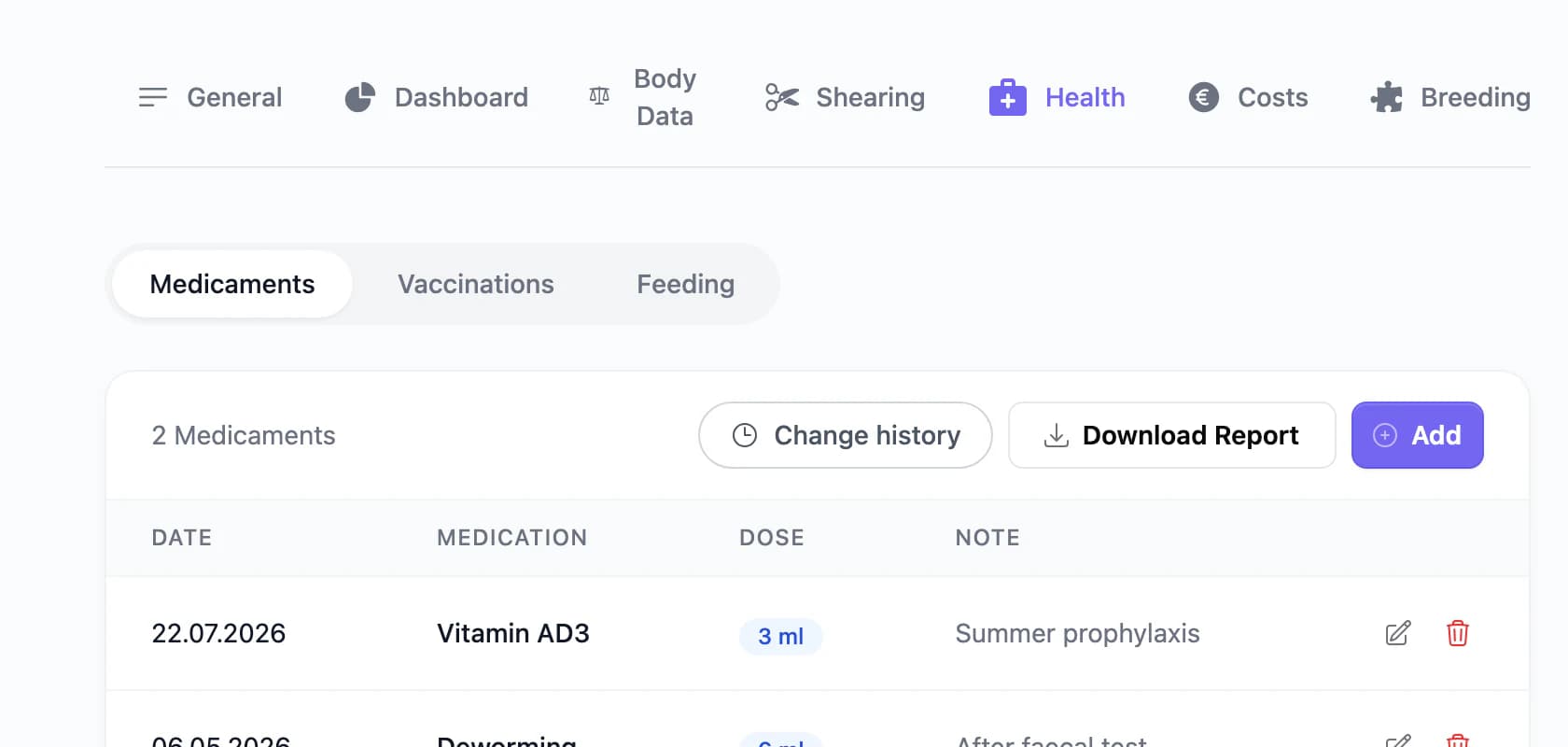
In ALPAKA.PRO, vaccinations, medication and treatments are kept in each animal’s health record. For the next vaccination, fecal sample or nail trim, you create a task with a reminder so nothing gets missed. You enter weight, temperature and body condition score in the app right at the animal, even without signal in the barn, and see the weight history as a chart. Findings and certificates are stored as documents in the animal profile. What else herd management can do is shown on the herd management page.
If your previous treatments are in an Excel spreadsheet, we transfer them for free as part of the data import. When switching from the spreadsheet pays off is covered in the article Managing Alpacas: Excel or Software?
Setting the plan with your vet
Vets with experience of South American camelids are not available everywhere. If you are starting out with alpacas or llamas, find out beforehand who will look after your herd. At a fixed appointment once a year, go through the vaccination plan, fecal samples and mineral feed with them and set the calendar for the following year. In between: because the animals hide illness for a long time, it pays to call the vet early, and immediately in case of colic.
Frequently asked questions
What are alpacas vaccinated against?
Mainly against clostridial diseases, usually combined with tetanus. After a primary course of two vaccinations, a booster is normally given once a year. Since bluetongue serotype 3 has spread, experts also recommend vaccinating llamas and alpacas against it. What makes sense for your herd depends on the region and the current disease situation. Clarify this with your vet.
How often do alpacas need deworming?
Not on a fixed schedule. The recommendation is to have fecal samples tested roughly every quarter and to treat only the animals that need it: young animals and animals with positive results, weight loss, diarrhea or pale mucous membranes. Routinely deworming the whole herd promotes resistance. Such resistance has already been found in German alpaca herds.
How often do alpaca toenails need trimming?
It depends on the animal and the ground. On soft ground the nails hardly wear down. Some animals almost never need a trim, others every 2 to 3 months. Check the nails once a month and trim them as soon as they extend beyond the sole.
Are there vaccines and dewormers licensed for alpacas?
Practically none. Hardly any veterinary medicines are licensed specifically for South American camelids. Vets therefore use products licensed for cattle, sheep or other species and prescribe them off-label. That is another reason why vaccinations and deworming belong in your vet’s hands and not in a plan from the internet.
Sources
- LFI Österreich; Wittek, T. et al. (Vetmeduni Wien): Neuweltkamele. Alpakas und Lamas in Österreich (2020)
- Wiedner, E.: Herd Health of Llamas and Alpacas. MSD Veterinary Manual (2021, updated 2026)
- Long, P. O.: Camelid Vaccinations. In: Cebra, C. et al. (eds.): Llama and Alpaca Care. Elsevier, 9–10 (2014)
- Vetmeduni Wien, Klinisches Zentrum für Wiederkäuer- und Kamelidenmedizin: Informationen zur aktuellen Situation der Blauzungenkrankheit bei Lamas und Alpakas (11/2024)
- LAVES; Niedersächsisches Ministerium für Ernährung, Landwirtschaft und Verbraucherschutz: Blauzungenkrankheit. Empfehlung zur Impfung (01/2026)
- Kultscher, L.; Hinney, B.; Schmäschke, R.; Joachim, A.; Wittek, T.: Current anthelmintic treatment is not always effective at controlling strongylid infections in German alpaca herds. Parasites & Vectors 12, 330 (2019)
- Hinney, B.; Wiedermann, S.; Vaneev, X.; Muhm, K.; Joachim, A.; Wittek, T.: High rates of benzimidazole-resistance-associated alleles in Haemonchus contortus and detection of resistance against macrocyclic lactones in strongylids from German alpaca herds. Parasites & Vectors 17, 296 (2024)
- APHA, Miscellaneous & Exotic Farmed Species Expert Group: Internal parasites in camelids (07/2026)
- Seehusen, F.; Wolf, P.; Ganter, M.; Schröder, C.: Rachitis bei einem Alpakafohlen. Tierärztliche Praxis Ausgabe G 36, 343–348 (2008)
- Landkreis Uelzen, Veterinär- und Lebensmittelüberwachungsamt: Merkblatt Alpakahalter